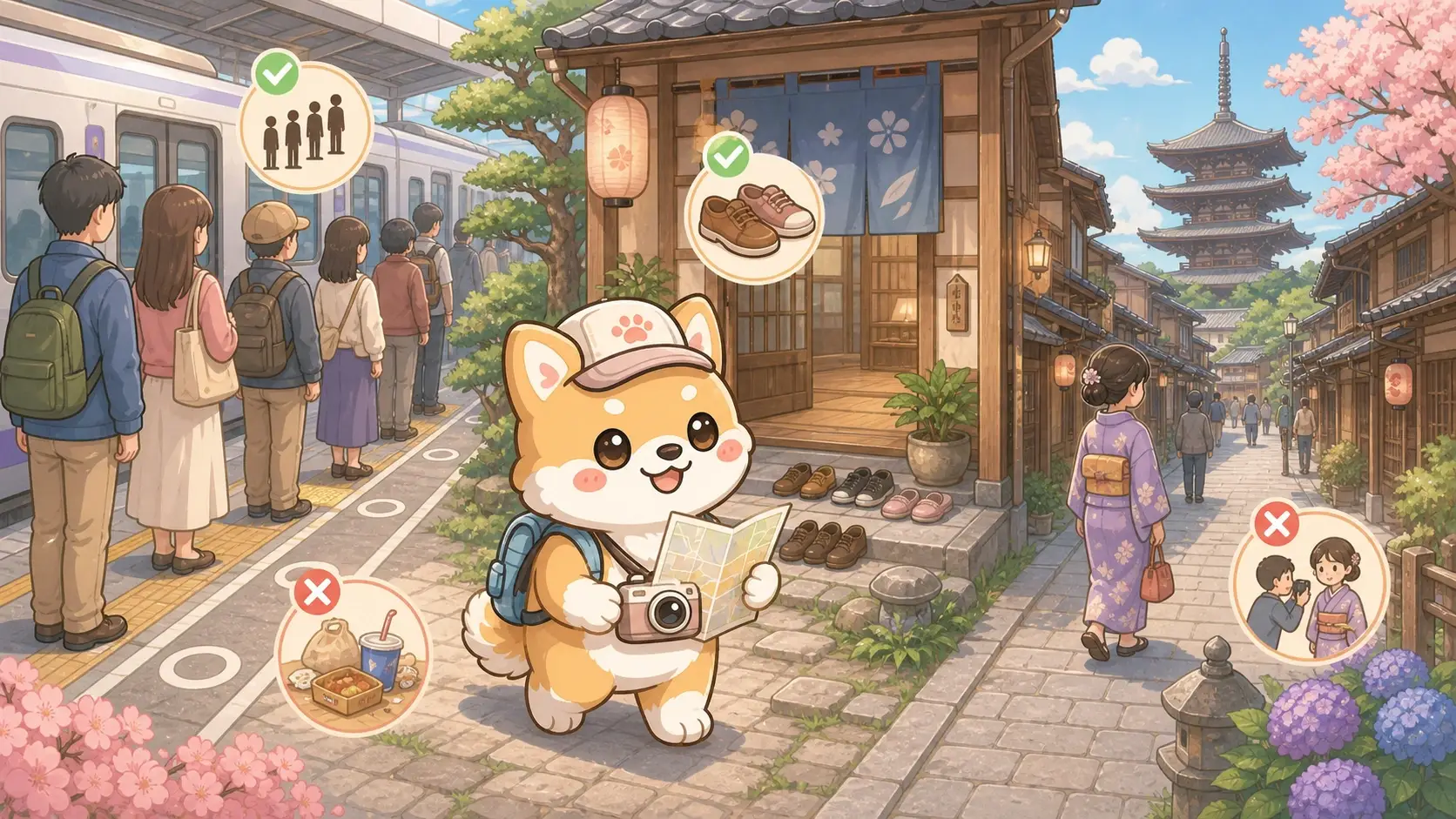
Things not to do in japan are not a morality quiz. They are habits that keep crowded rooms from becoming loud rooms: quiet trains, shoes off, queues that mean queues, and cameras down when someone is working in kimono. Copy the people already in line and you usually vanish into the scenery.
This is a list of fifteen, with a “why,” not a scolding. Chopsticks have their own page: chopstick etiquette japan. Money in envelopes has its own page: do you tip tour guides in Japan.
Japan etiquette for tourists (the tone)
Japan etiquette for tourists is mostly volume, space, and shoes. It is not secret handshakes. If you are unsure, watch the nearest Japanese person who is not performing for a camera and do that, slower.
Etiquette in japan for tourists blogs love bans. Real life loves not blocking a ticket gate. The fifteen below are the ones that actually produce a stare, a staff intervention, or a neighborhood complaint. Being lost, asking twice, or using a translation app in the aisle is not on the list.
Things not to do in japan as a tourist: the fifteen
Things not to do in japan as a tourist if you want a boring, successful week:
1. Talk on the phone in a quiet car
Trains are libraries with seats. Text. Step off at the next station if the call is real. Watch the Motoyawata Station live camera for the commuter density: that many people only works if most of them are silent.
2. Eat while walking through a scramble or shrine approach
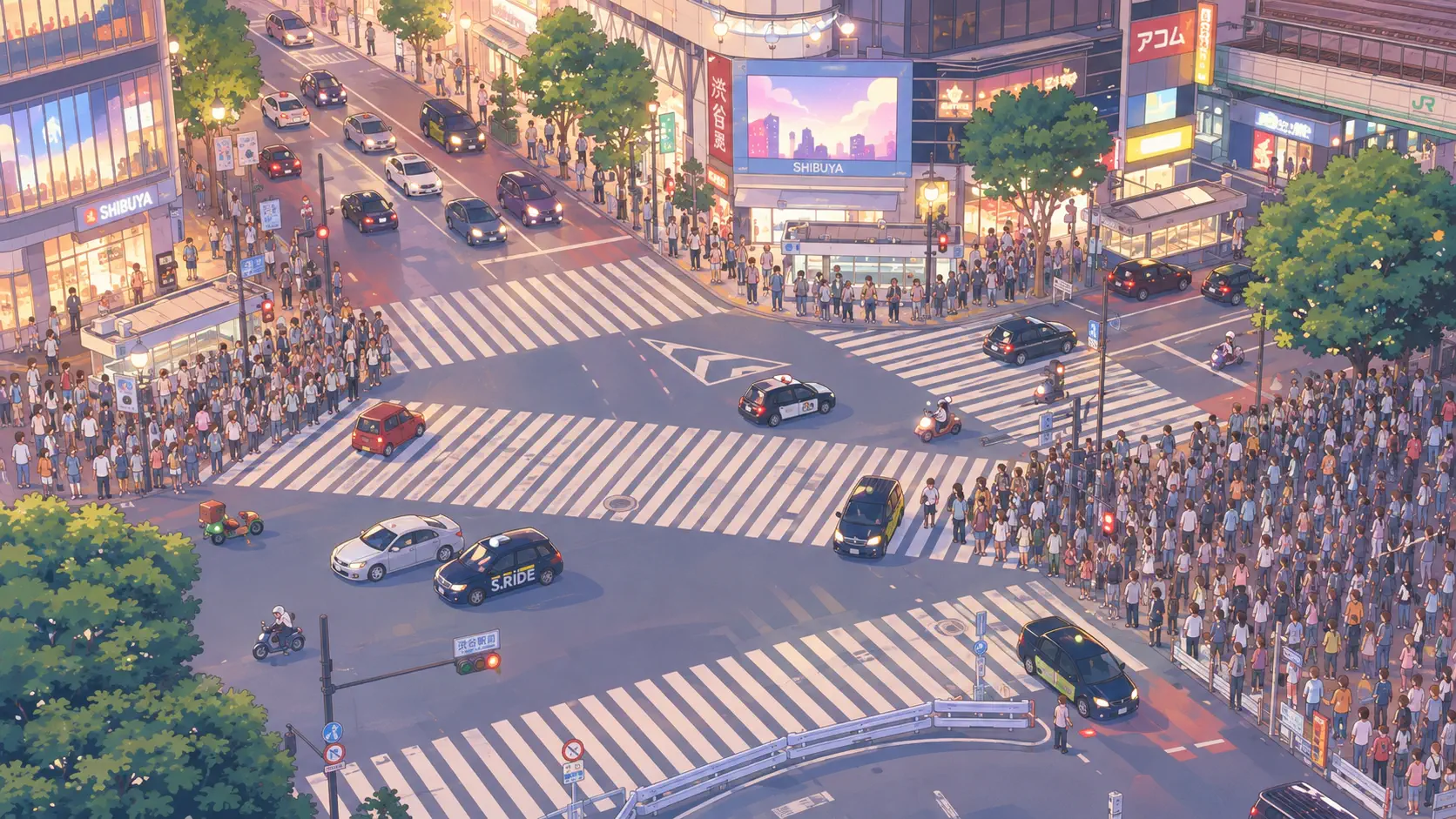
Snacks exist. Moving mouthfuls in a dense crowd spray other people. Step to a bench, a park, or the shop’s standing area. Shibuya Crossing is the extreme version of this physics problem. Temple approaches around Asakusa are the polite version. Street cakes and melon pan still taste fine when you stop: japanese mini taiyaki, melon pan turtle.
3. Wear shoes on tatami or past the genkan
The step-up is the line. Follow the slippers. Bathroom slippers stay in the bathroom. This is in the japan packing list for a reason: socks without holes.
4. Tip as a reflex
No. The full map is do you tip tour guides in Japan. Pushing cash into someone’s hand can look like you think the price was incomplete.
5. Cut a queue, including a painted floor queue
Stations, bakeries, taxis, and temple offices run on lines. The Kyoto Station Hachijo taxi stand live camera is a moving diagram of people waiting in order. Join the back.
6. Photograph geiko and maiko on Gion streets as if they are exhibits
They are commuting to work. Tours that chase them have made parts of Gion hostile. No candid telephoto. No blocking the alley. If a venue sells a show ticket, that is the photo you paid for.
7. Plant chopsticks in rice or pass food stick-to-stick
One line on a public-space list. The funeral pair, the rest, and where to put them when you are done: chopstick etiquette japan.
8. Blow your nose at the table like a trumpet
Step out. Sniffing is less rude than the honk, which is the reverse of some Western tables.
9. Pour only for yourself in a shared izakaya
Pour for others; they pour for you. Solo dining is different — then you pour for yourself and nobody cares.
10. Get in the onsen water with a towel, swimsuit, or soap
Wash first. Towel on the head or the side. Tattoo policies vary by bath; read the sign instead of debating the internet.
That is a usable 10 things not to do in japan. The next five are how people still get it wrong after they memorized a top ten.
Top 10 things not to do in japan — then five more
Top 10 things not to do in japan lists stop at the photogenic rules. These five are quieter and still get staff involved:
11. Leave trash on a utility pole because you cannot find a bin
Carry it to the hotel or a konbini bin. Japan has fewer public cans than visitors expect on purpose.
12. Block the train door while you decide which exit is “cute”
Stand aside, let the flow out, then enter. Backpacks off in rush hour.
13. Touch offerings, climb into shrine photography, or ignore a no-photo sign
The rope and the sign are the rule. Your wide-angle is not a permit.
14. Play music or videos on speaker in a carriage or a quiet café
Headphones. Even “just for a second.”
15. Treat a convenience-store microwave queue as a picnic assembly zone
Grab, pay, step aside. The japanese convenience store food map assumes you already left the aisle.
Things to not do in japan (the awkward search)
Things to not do in japan is the same list with the words in a knot. Search boxes do that. The content does not change: volume, shoes, lines, cameras, sticks, money.
If you only remember three: quiet train, shoes off, do not chase kimono in an alley.
Things to do and not to do in japan
Things to do and not to do in japan is a false pair. The “do” side is ordinary: say sumimasen, stand on the correct escalator side for that city (Tokyo vs Osaka differ), put coins in the tray at a register, recycle if you see the slot.
The “not” side is this page. Combining them into one inspirational graphic usually drops the “why” and keeps the scold. Keep the why. People follow reasons.
A hot bowl after you did the rules right still matters. Cheap eats in Tokyo is how you eat without turning every meal into a reservation. Vegetarian broth traps are what to eat in Japan as a vegetarian.
What this is not
It is not “Japan is fragile.” It is not “one mistake ruins the country.” It is a dense place with thin walls and shared vehicles. The same week you will see Japanese groups being loud at a festival and silent on the last train. Context is the rule.
Staff who correct you are doing their job. Thank them. Do not argue that your country does it differently. Your country is not paying this shop’s rent.
FAQ
Will people hate me if I get one rule wrong?
They will forget you in ten seconds unless you doubled down.
Is eating on the shinkansen OK?
Yes. Long-distance trains are designed for it. Local rush-hour cars are not.
Can I take photos in a shrine?
Often the grounds, not always the inner hall. Read the sign. Do not photograph people praying as content.
What about tattoos in onsen?
Policy is local. Some baths ban, some cover, some do not care. Ask or pick a tattoo-friendly bath.
Is smoking on the street banned?
Many city streets restrict it to designated corners. Follow the painted box.
Do I need a phrasebook of apologies?
Sumimasen covers 90%. Then stop doing the thing.