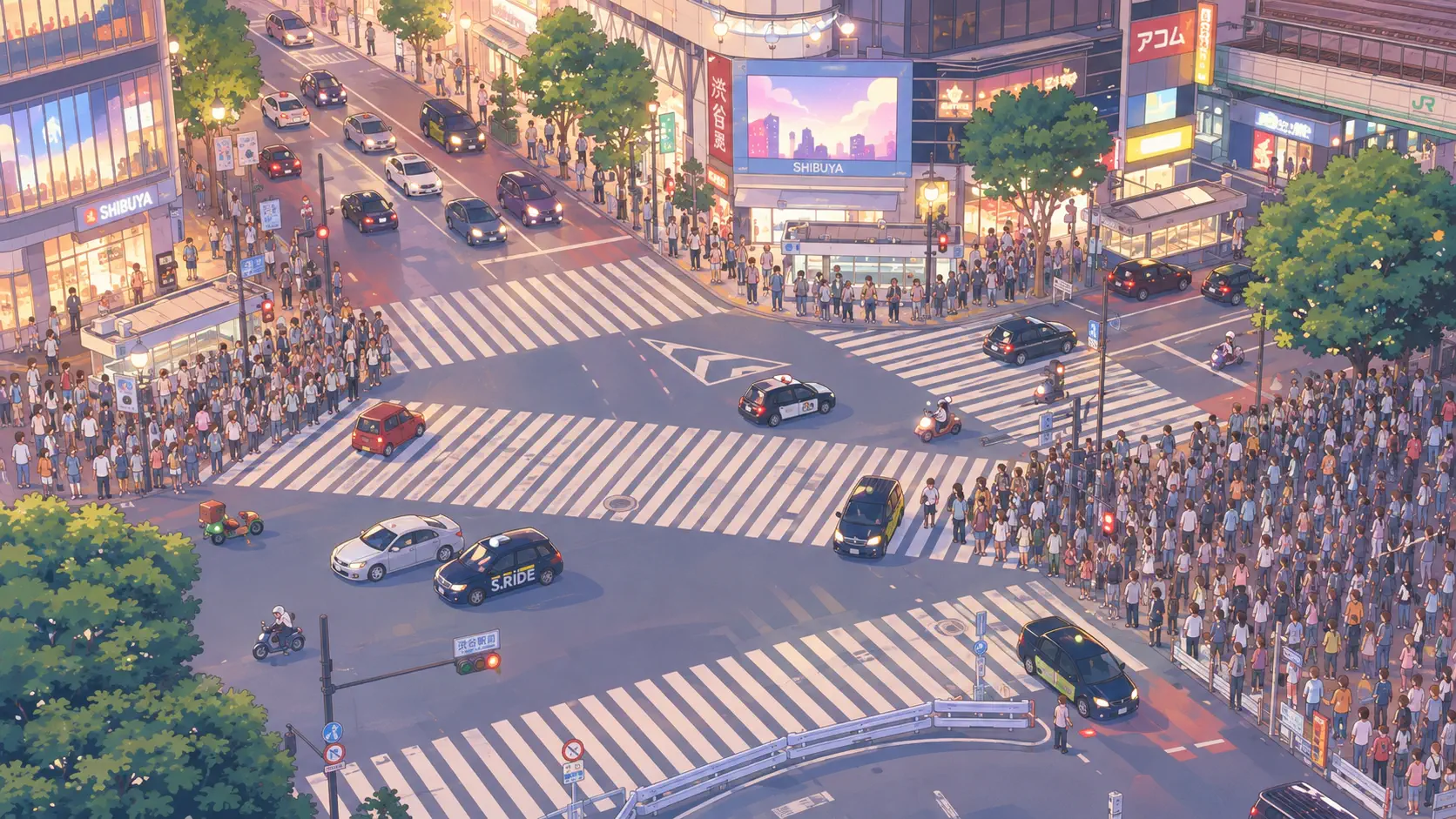

Cross Shibuya Scramble, pass Hachikō, duck under the Center-Gai arch, and Tokyo’s youth culture compresses into a single narrow canyon of signage, fried-food steam, and fashion anxiety. Center-Gai (センター街) — officially Center Street — is Shibuya’s self-declared “center,” a pedestrian-priority lane in Udagawachō (宇田川町) that has channeled gyaru, visual kei, street dance, and every subsequent trend since the 1990s golden era. This live webcam anchors on the main archway framing the lane that feeds the Scramble Crossing — not the crossing itself (Shibuya Crossing cam) and not the Ai Vision billboard on Miyamasuzaka (Shibuya Ai Vision). You are watching the threshold where suburban teenagers become Tokyo performers.
About This Live Camera
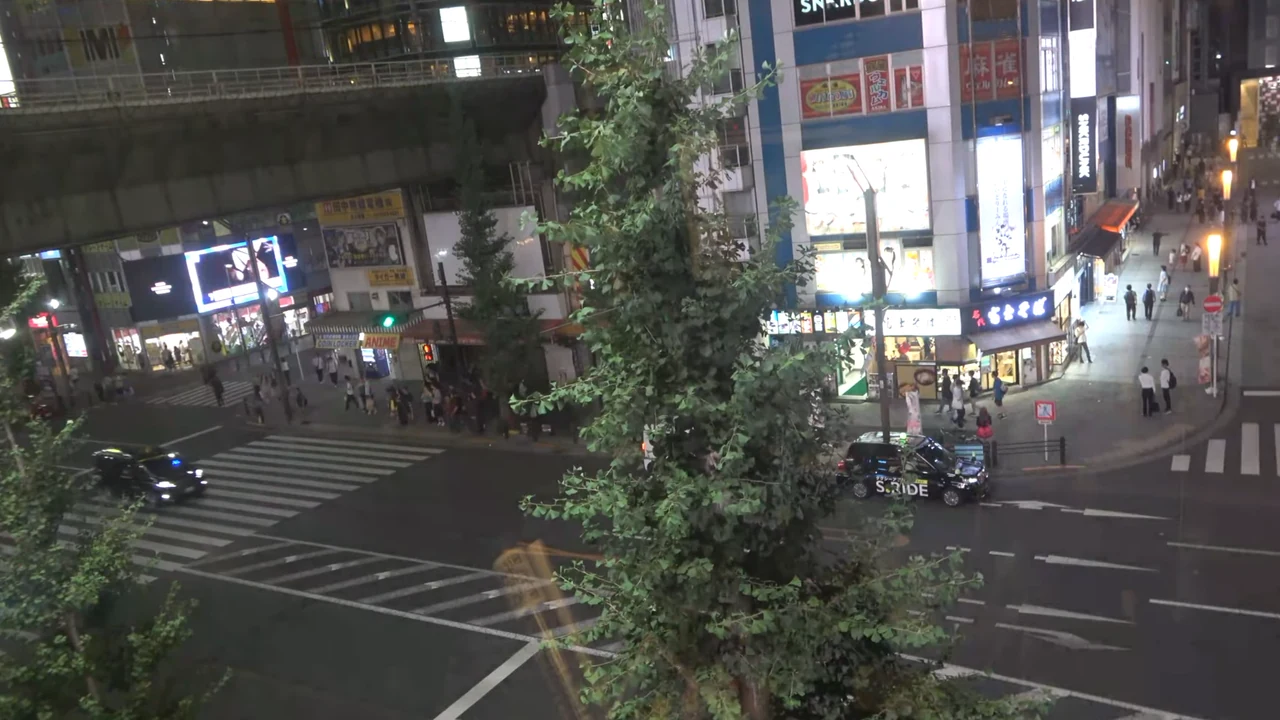
The HD stream (YouTube d1JuNg7knNo) looks along Center-Gai from the Udagawachō end toward the Scramble mouth — capturing the iconic arch sign, shop facades, crowd density, and evening neon activation. Source catalog lists multiple alternate embed IDs; d1JuNg7knNo is primary with autoplay=1 parameters in upstream metadata.
Static framing emphasizes pedestrian flow and street-level retail energy rather than aerial scramble geometry. Ideal for observing weekend peak youth density, Halloween approach waves, and weeknight club queue formation on adjacent Dogenzaka spurs not fully visible but implied by crowd direction.
What You Can See
Center-Gai arch — rebuilt after 1997 typhoon tragedy — frames the street entrance. Fast-fashion and chain restaurant signage (Gyoza Loup, ** Karaoke** joints, clothing discounters) lines both sides. Pedestrians move in both directions: outbound toward Parco, Loft, Marui orbit; inbound toward Scramble and Shibuya Station.
Evening: neon and LED compete; weekend density can slow walking to shuffle pace. Rain: umbrella tunnel effect under arch — Tokyo classic. Daytime: delivery trucks and staff restocking — backstage city. Occasional street performers and campaign staff with signboards during election seasons.
Location
Center-Gai runs east-west through Udagawachō, Shibuya-ku, Tokyo (35.660°N, 139.698°E), east end at Shibuya Scramble Crossing, west end connecting toward Yumeji Street and Dogenzaka nightlife hill. Nearest station: Shibuya — Hachikō, Center-Gai, and Scramble Square exits all within ~3 minutes’ walk.
Geologically, the street covers culverted Udagawa River channels — Shibuya built over its waterways; Center-Gai literally spans what was once open water toward Shibuya River confluence.
History
Udagawachō began as “Udagawa back street” (宇田川裏) — 1930s embankment works culverted Udagawa after repeated floods. 1955 station-front readjustment named the zone a downtown rival to Shinjuku. 1961 Shibuya Center Shopping Association formalized Center-Gai branding — commercial coalition against Osaka and Shinjuku youth gravity.
1990s cemented legend: Shibuya 109 (1996 nearby) exported gyaru fashion; Center-Gai became runway and laboratory. Economic stagnation after the bubble burst pushed youth to invent identity through clothing rather than corporate career paths — Center-Gai supplied the stage.
June 20, 1997: Typhoon Opal (Kuring) winds collapsed the 4-ton Center-Gai arch, killing one man and injuring others — a rare urban disaster that forced structural rebuild and safety audits. Today’s arch is successor engineering — watch it hold against storm-season gusts with sober respect.
2000s–2010s: global tourism discovered Scramble; Center-Gai absorbed foreign street-culture pilgrims alongside Kanto suburban kids. 2020s Shibuya redevelopment (Scramble Square, Fukuras, Miyashita Park) upgraded station periphery without killing Center-Gai narrow intimacy.
Why Watch
Because Center-Gai is Tokyo youth culture’s longest-running live stage — not a museum, a nightly rehearsal. Because this camera shows approach energy before scramble geometry — how crowds gather density funneling toward the world’s most photographed crossing. Because fashion, nightlife, and subculture history leave visual traces in hair, bag size, and group choreography even on low-resolution streams.
Researchers comparing Shibuya vs Harajuku vs Akihabara should bookmark this feed alongside Koen Dori for north-south Shibuya contrast.
Daily Life
Afternoon: high-school and university groups, tourist families mixing with cosplay shoppers. Early evening: after-school fashion pilgrimage peaks. Late night: club-bound cohorts peeling into Dogenzaka side streets — Center-Gai as anteroom to nightlife.
Retail staff smoke breaks in alley gaps; police patrol softly on weekend nights — visibility without constant intervention. Street cleaning early morning resets garbage from late-night fast food — watch 05:00 streams for municipal diligence.
Best Time of Day
- 15:00–18:00: school-university overlap; maximum youth fashion signal
- 20:00–23:00: pre-club density; neon fully saturated
- Friday–Saturday 22:00+: peak social energy before last trains (~midnight–01:00 depending on line)
- Weekday morning: surprisingly quiet — delivery and office cut-through
Halloween October 31 exceeds all schedules — arrive via cam before committing physically.
Best Seasons
Spring: graduation and enrollment fashion displays — sartorial optimism. Summer: Tanabata-adjacent yukata sightings; humidity-wilted crowds still massive. Autumn: Halloween build-up; crisp neon contrast. Winter: illumination on adjacent Shibuya Scramble Square spills glow; New Year youth hatsumōde flows toward Meiji Jingu via Harajuku side routes.
Events
Shibuya Halloween (Oct 31): Center-Gai becomes costumed river — camera essential safety preview. Shibuya Fashion Week adjacency — street style intensifies. Election cycles: poster boards and sound trucks on periphery. Typhoon days: arch stability history makes weather watching culturally loaded.
Scramble Square rooftop events don’t fill this frame but swell downstream pedestrian volume visible as surges toward arch.
Getting There
JR Shibuya Station — exit toward Hachikō, face Scramble, Center-Gai arch visible across intersection — ~30 seconds if crowds permit. Tokyu, Keio, Metro lines same hub. From Harajuku/Omotesando, walk south ~15 minutes through Cat Street alternatives for calmer approach.
Interesting Facts
- Center-Gai spans culverted Udagawa River — water still flows underground.
- 1997 arch collapse during Typhoon Opal killed one person — rebuilt arch is post-tragedy engineering.
- Shibuya 109 and Center-Gai together defined 1990s gyaru globalization.
- East end terminates at Scramble Crossing; west links Dogenzaka club hill.
- ~35.660°N, 139.698°W coordinates place camera at Udagawachō retail core per source map.
- GO TOKYO official tourism lists Center-Gai as “capital for youth culture, fashion, and music.”
- Shibuya Culture Project documents Udagawa back street genealogy back to 1929 flood works.
- Name “Center-Gai” asserts Shibuya as Tokyo’s center — marketing defiance against Shinjuku and Ikebukuro rivals.
The Arch as City Gate
Rebuild arch is more than signage — it is liminal architecture. Psychologically, crossing beneath marks entry into youth territory the way torii mark sacred ground. Watch stream viewers’ chat during Halloween — many treat arch appearance as “we’re inside Shibuya proper now.”
Engineering after 1997 increased wind-load tolerance — typhoon season makes the arch a weather vane for urban safety culture.
Center-Gai vs Scramble: Funnel Physics
Scramble Crossing cameras show release — pedestrians exploding outward green-light. Center-Gai cam shows compression — groups narrowing into single-file excitement before release. Together they document crowd thermodynamics unique to Shibuya.
Tour groups pause for arch photos; locals slide edges — watch lane splitting behavior repeat nightly.
Retail Layers: Fast Fashion to Nightlife
Center-Gai storefronts rotate faster than ward planning maps update — fast fashion chains anchor foot traffic while upper floors hide pachinko, karaoke, and internet cafes from street view. The camera catches facade turnover through signage changes: a shuttered CD shop becomes smartphone accessories becomes bubble tea within a single business cycle.
Dogenzaka branches off the west end — Love Hotel Hill geography separate from family retail here, but late-night crowd overlap visible when groups reverse direction after midnight trains end. Weekend street performers (dance crews, cosplay photo circles) claim alcoves near the arch — spontaneous culture the city tolerates within noise ordinances.
Udagawa River Underground
Before Center-Gai existed as brand, Udagawa flowed openly through Shibuya toward Shibuya River. 1929 flood-control projects began culverting; by 1935 eateries lined the newly dry corridor. Knowing water still runs beneath explains occasional summer humidity trapped in the canyon and why Typhoon Opal wind loads on the arch mattered — gust channels accelerate between buildings like urban river rapids replaced by air.
Shibuya Culture Project walking tours describe this hydrology; the webcam supplies continuous present to that history lecture. Repeat viewers often notice seasonal menu boards and campaign mascots rotating monthly — subtle indices of Japan’s retail calendar without reading Japanese fluently.
Hungry after watching the retail river? Our cheap eats in Tokyo guide maps standing counters and station meals that fit Center Street pacing without tourist-plaza prices.
Nearby Live Cameras
Complete Shibuya triad with Shibuya Scramble Crossing for intersection geometry, Shibuya Ai Vision for Miyamasuzaka message screen, and Koen Dori for north Shibuya shopping boulevard pace.
Frequently Asked Questions
Is this the Shibuya Scramble Crossing camera?
No. This camera faces Center-Gai street and its archway toward scramble — the Scramble Crossing cam watches the intersection itself.
What is Center-Gai?
Center-Gai (センター街) is a pedestrian-focused shopping street in Udagawachō, Shibuya — Tokyo’s historic youth culture hub linking Scramble to Dogenzaka.
How is Center-Gai different from Miyamasuzaka / Ai Vision?
Center-Gai is west of scramble in Udagawachō. Miyamasuzaka Ai Vision is east of scramble — see Shibuya Ai Vision page.
What happened to the Center-Gai arch in 1997?
Typhoon Opal winds collapsed the 4-ton arch (June 20, 1997), killing one person — the structure was rebuilt to improved safety standards.
When is the street busiest?
Weekend evenings (20:00–23:00) and Halloween — weekday afternoons also busy with students.
Does the stream run 24/7?
YouTube ID d1JuNg7knNo — verify live status; third-party cams may reset periodically.
Where is Udagawachō?
Udagawachō is the address district containing Center-Gai, west of Shibuya Station and Scramble Crossing.