
Chuo-dori is Akihabara’s main stage. If Electric Town were a theater, this avenue would be the proscenium: wide enough for cars and tourist buses, tight enough that every sidewalk still feels like a queue forming. This live camera page focuses on that central street energy — not a quiet back alley of parts shops, but the boulevard where Tokyo’s pop-culture commerce announces itself in traffic lights, crossing tones, and building-sized illustrations.
About This Live Camera
The stream is oriented toward Akihabara’s Chuo-dori corridor in Chiyoda, where storefronts and multi-floor retail towers face the roadway. When the feed is active, you are watching a negotiation between vehicles and pedestrians that repeats hundreds of times a day. The interest is not one famous statue. It is the recurring choreography: wait, surge, clear, wait again — while the façades sell fantasy at full brightness.
Because this page’s stream source can be intermittent, treat the camera as a recurring check-in rather than a guaranteed 24-hour channel. When it is online, it is one of the best remote tools for reading how busy Akiba feels right now.
What You Can See in the Live View
Look first at the roadway: taxis, delivery vans, private cars, and the occasional tour bus stacked at signals. Then look at the sidewalks. On strong visitor days they thicken into slow rivers of people carrying shopping bags, camera straps, and phones held up for vertical video. Building fronts carry the district’s signature visual language — anime and game artwork stretched across glass and panels — so even a short glance tells you which franchise season the street is living through.
At night the balance flips. Headlights and neon become equal actors. The road reads as a ribbon of moving light; the buildings become billboards with weather. Rain intensifies everything. Dry midday light can make the same street look oddly ordinary, which is useful: it reminds you that Akihabara is still a working city artery, not only a costume.
Location and Surroundings
Chuo-dori runs through the commercial heart of Akihabara west of the station complex. Around it sit the major hobby towers, electronics retailers, arcades, and café floors that define modern Akiba tourism. Side streets branch into denser pedestrian pockets — some quieter, some even more intense — but the central street is where the district presents its public face to people arriving by train.
That matters for watching. A backstreet camera would show niche texture. A Chuo-dori camera shows the district’s pulse as most visitors encounter it: exposed, loud, photogenic, and constantly interrupted by traffic engineering.
Visible Landmarks and Street Signals
Exact landmarks depend on the lens angle, but typical cues include large retail blocks with rotating exterior wraps, elevated rail infrastructure near the station approach, and the broad crossing zones that organize pedestrian release. Temporary stage trucks or promo booths sometimes appear for launches. Even without naming every building, you can track change over weeks: a new character face on a tower is as clear a seasonal marker as leaves in a park.
Listen with your eyes for the crossing cycle. Tokyo’s scramble moments are famous in Shibuya; Akihabara’s version is narrower and more commercial, but the same civic music plays — the chirp, the surge, the reset.
History Along the Avenue
Chuo-dori’s electronics identity did not begin with anime. In the immediate postwar years, radio and parts dealers concentrated near Akihabara Station and along approach streets because the area was accessible and commercially opportunistic. As Japan’s consumer economy accelerated, appliance showrooms and discount competition turned these corridors into destination retail. Shoppers came from across the region for televisions and white goods long before overseas visitors came for figures.
When personal computers and then game culture surged, the avenue’s façades adapted. The physical street stayed a street; the merchandise and the signage changed genre. That is the quiet historical joke of Chuo-dori: the asphalt remembers trucks and appliances, while the walls currently speak in limited editions.
Redevelopment around the station in recent decades added taller, cleaner commercial volumes. The result is a layered skyline — older mid-rises and newer glass — that the camera records without commentary.
Why This Street Matters
Chuo-dori matters because it is where Akihabara’s private obsessions become public infrastructure. A hobby can live online forever without needing a boulevard. Akihabara’s reputation required one: a place where strangers can see that fandom has square footage, landlords, opening hours, and traffic cops.
It also matters as a comparative Tokyo street. Ginza’s Chuo-dori sells luxury polish. Akihabara’s sells intensity and specialty. Watching both kinds of avenue remotely is a fast lesson in how the same city uses the same street typology for different desires.
Daily Life and Activity
Early hours favor logistics. Shutters rise, goods move, staff unlock doors. Midday mixes errands with tourism. After school and after work, the sidewalk composition shifts younger and more leisure-focused. Evening is peak spectacle for remote viewers: more people, more light, more chance of someone in costume passing through a crosswalk like a plot point.
Mondays can feel comparatively calm. Weekends and holiday bridges can turn a simple crossing into a patient shuffle. If you are planning a real visit, a ten-minute watch on a Saturday afternoon is more honest than any “best time” listicle.
Best Time of Day to Watch
Evening is the signature. If you want readable storefront detail and softer crowd density, late morning works. For pure movement studies — how people and cars share a constrained commercial canyon — rush-adjacent periods are ideal.
Typhoon approach days are strangely compelling: umbrellas, empty intervals, and the street’s brightness fighting gray air. Just remember that severe weather can also take cameras offline.
Best Seasons and Weather
Autumn evenings are particularly kind to this view: comfortable temperatures keep people outside longer, and clear air helps signage pop. Spring brings hanami visitors into central Tokyo and often into Akiba as a second stop. Summer humidity can flatten contrast at noon but rewards night watching. Winter’s early dark means you get “night Akiba” before dinner.
Events and Celebrations
Product launches and collaboration cafés are the street’s true festivals. When a major anime film or game ships, expect denser foot traffic and fresh exterior art. New Year periods and Golden Week push tourist volume. Occasional public performances or countdown-style events can briefly reassign sidewalk space.
The camera will not title these moments. You infer them when the crowd thickens and the walls change costume overnight.
Transport and Access
JR Akihabara Station dumps pedestrians toward this commercial field within minutes. The Hibiya Line and Tsukuba Express add more arrival vectors. Once on Chuo-dori, walking is the point — though “walking” may mean negotiating photo stops and tour groups. For accessibility, the broad avenue is easier than some side alleys, but weekend congestion can still be challenging.
Interesting Facts
- Chuo-dori is not uniquely “Akihabara’s invention”; it is a common Japanese main-street name. What is unique is the merchandise ecology attached to this segment.
- Many of the most photographed “Akihabara buildings” are temporary skins on ordinary commercial structures.
- The street’s electronics ancestry still peeks through in parts shops and appliance floors even when tourist attention stays on character goods.
- Maid cafés and related themed dining clustered here because foot traffic and tourist intent were already concentrated — culture followed density.
- Watching Chuo-dori remotely is one of the few ways to see advertising calendars change in near real time without buying a plane ticket.
How to Read the Street Like a Local
Remote watching becomes sharper if you assign meaning to small cues. A cluster of suitcases near a curb often means a tour group between electronics floors and the next café booking. A sudden line outside one doorway can signal a same-day merch drop. Staff in matching jackets arranging stanchions usually means an evening event will thicken the sidewalk later. None of these cues require Japanese literacy — only patience.
Also watch the opposite sidewalk. Chuo-dori is a two-sided conversation. When one façade launches a new wrap, the other side answers with lighting and queue management. The avenue is competitive theater, and competition is readable.
Sound You Can Almost Hear
Even on a silent stream, Akihabara suggests audio: crossing chirps, bus brakes, the muffled thump of bass from an anime store doorway, suitcase wheels on tactile paving. Imagining that soundscape while you watch is not sentimental; it is how the place works. The district sells immersion. The camera gives you the outdoor half of that immersion for free.
A Practical Remote Itinerary
Try a three-pass watch. First pass: ignore people and map the buildings. Second pass: ignore buildings and track only crossing cycles. Third pass: follow one pedestrian from edge to edge of the frame. Ten minutes of that will teach you more about Akiba’s outdoor grain than an hour of highlight reels.
Nearby Live Cameras
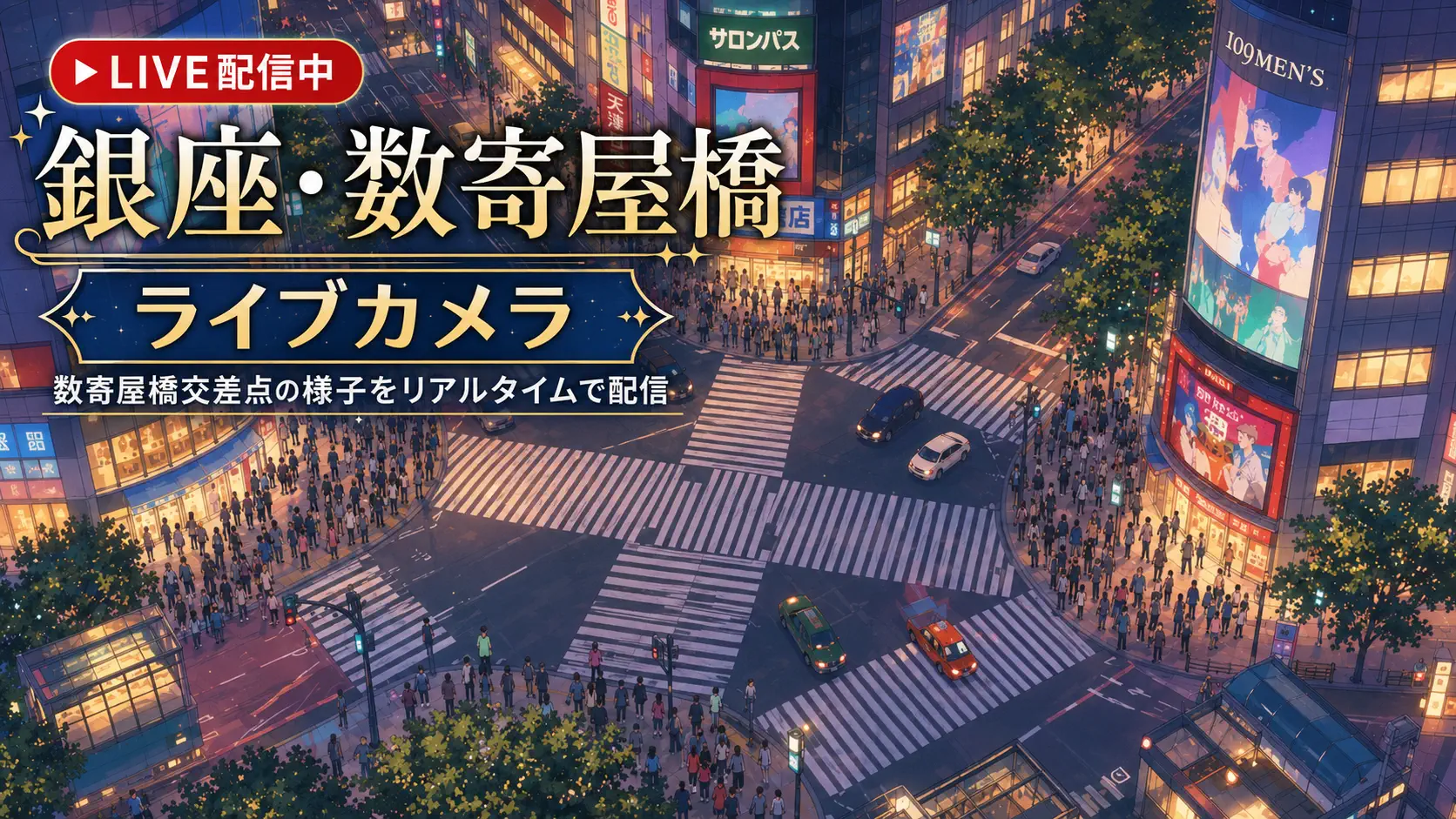
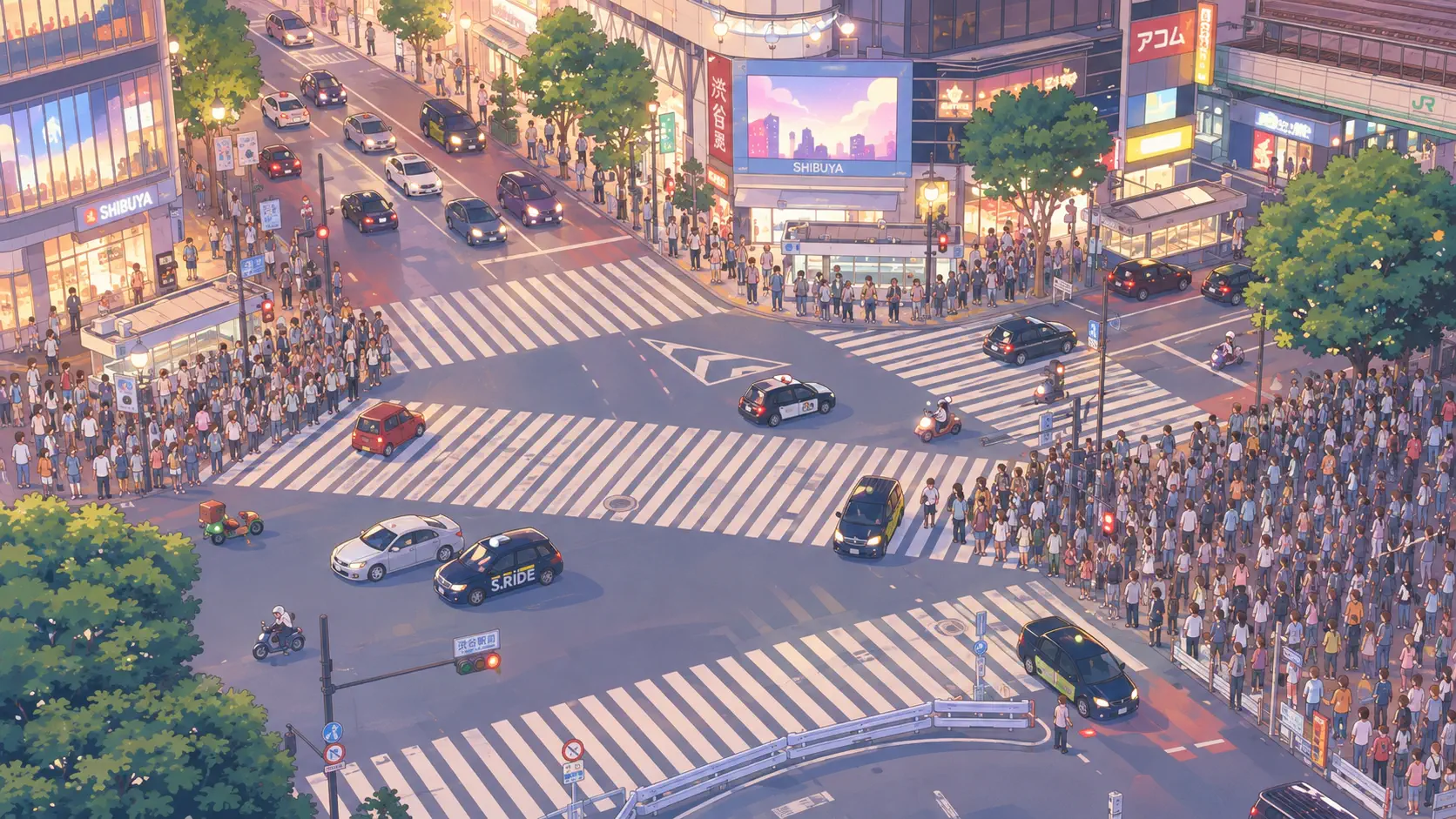
Switch to Ginza Sukiyabashi Crossing for a luxury-district crowd pattern, or Shibuya Crossing for Tokyo’s most famous pedestrian release valve.
Frequently Asked Questions
Is Chuo-dori the same as “Electric Town”?
Electric Town refers to the wider Akihabara commercial district. Chuo-dori is the main road cutting through it — the spine, not the whole body.
Why is there no stream sometimes?
Public camera sources change, pause, or fail. This page stays ready for a verified embed; when the player is empty, the location guide still stands.
Is this a good camera for checking rain?
Yes. Umbrella density and road sheen are easy to read on an avenue this wide.
Will I see cosplay every time?
No. Cosplay and character fashion appear more on weekends and event days. Ordinary streetwear is the default.
How close is this to Akihabara Station?
Very close — typically a short walk from the main exits into the commercial blocks facing Chuo-dori. Exact walking time depends on which exit you use and how crowded the sidewalks are.