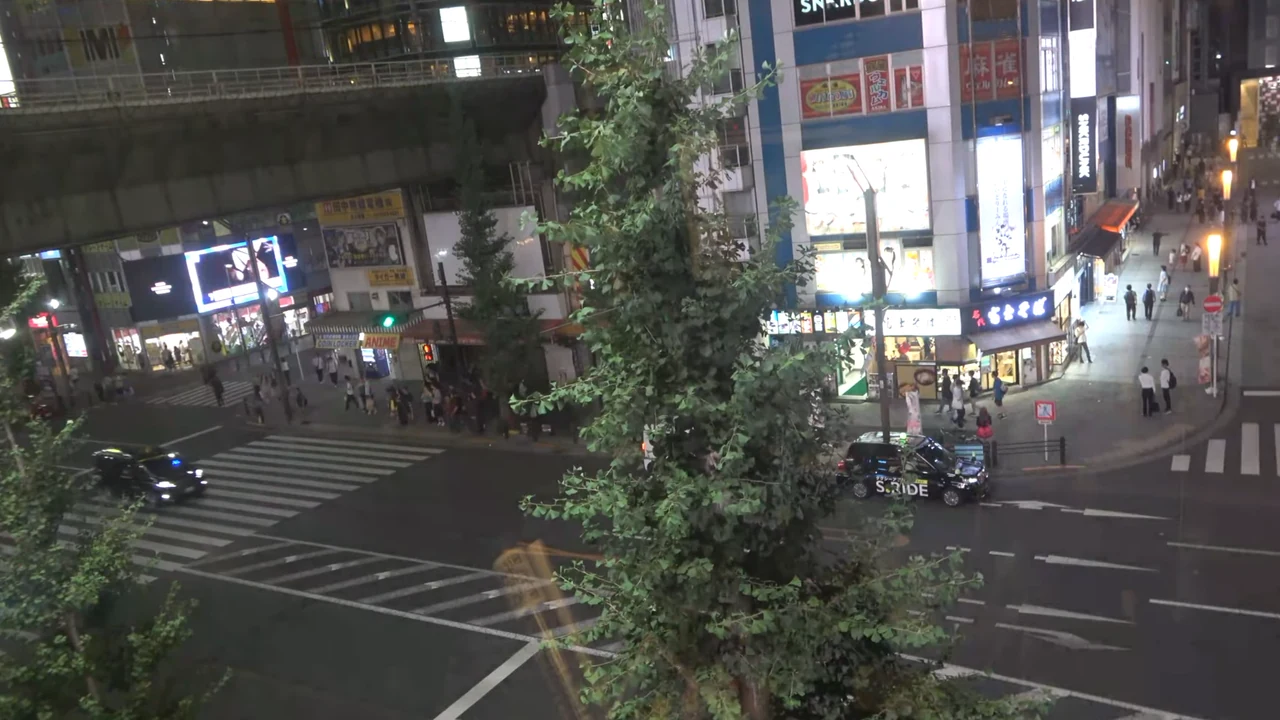

Tokyo after dark has neighborhoods with reputations that precede their geography. Kabukicho, in Shinjuku Ward, is one — an entertainment district of neon, restaurants, theaters, karaoke towers, and nightlife that stays awake when office Shinjuku goes home. This live camera is not the Ichiban-gai street-level nightlife stroll — that is a sibling view with different framing — but the Kabukicho Crossing itself: traffic on Yasukuni-dori, pedestrians threading Moa 4th Street and Azuma-dori, and the urban canyon seen from the Teikei head office building vantage. At the far visual depth, rail lines run north–south between Seibu-Shinjuku Station and Shinjuku Station, reminding you that even Japan’s most talked-about night map is still, fundamentally, a train-city.
Treat Kabukicho with curiosity rather than cliché: it is a dense commercial ward where families live nearby, cinemas operate, and tourists eat ramen at 02:00 — not a monolithic stereotype. The crossing cam shows public street life at the district’s arterial edge.
About This Live Camera
The HD stream overlooks Kabukicho Crossing — Shinjuku Kabukicho crossing along Yasukuni-dori Avenue, part of Tokyo Metropolitan Road 302, at the intersection with Moa 4th Street and Azuma-dori. The camera mounts at the Teikei building headquarters, giving elevated sightlines over signal cycles, buses, taxis, and the evening swell of foot traffic entering or leaving the entertainment core.
Coordinates near 35.693°N, 139.702°E place you in one of Tokyo’s most densely built wards. When live, you read light, rain on asphalt, umbrella rivers, and the doppler of a city that never fully powers down — even if individual bars do close.
What You Can See in the Live View
Traffic on Yasukuni-dori: taxis dominate late hours, buses cut fixed lines, private cars navigate aggressively tight lanes. Pedestrians cluster at crosswalks — after-work drinks, theater let-outs, hotel arrivals, night-shift workers, tourists filming responsibly or not. Neon and signage begin at dusk and peak near midnight; rain turns the road into a mirror doubling kanji and LED colors.
In the distance, elevated or at-grade rail hints connect mentally to Seibu-Shinjuku and JR Shinjuku — the world’s busiest station by some passenger counts, though this cam catches its aura more than its platforms. High-rise silhouettes frame Kabukicho as vertical Tokyo — signage stacked up facades, air-conditioning units, rooftop machinery.
Daytime views show a different district: deliveries, maintenance, quieter foot traffic — proof Kabukicho is not only midnight mythology.
Where Is Kabukicho Crossing?
In Shinjuku Ward, Tokyo, northwest of JR Shinjuku Station’s east exits, within walking distance of Seibu-Shinjuku, Shinjuku-sanchōme subway nodes, and the Golden Gai micro-bar alleys (slightly east — not in frame but culturally adjacent). Shinjuku Gyoen, Metropolitan Government Building observatories, and Ōdakyū department store gravity sit nearby, compressing tourism, governance, and nightlife into one walkable kilometer-scale patch.
Kabukicho occupies the northern entertainment pocket of greater Shinjuku — bordered by Yasukuni-dori’s traffic energy and quieter residential high-rises on other sides. The crossing cam sits on the Yasukuni-dori edge where cars still rule and pedestrians negotiate visibility.
History: From Postwar Rebuild to Entertainment Geography
Shinjuku rebuilt after World War II bombing into a dual personality: commercial west (department stores, bus terminal, skyscrapers) and nightlife north (Kabukicho). Kabukicho’s name echoes unbuilt kabuki theater plans; reality became cinemas, bars, host clubs, love hotels, and later TOHO Cinemas, Robot Restaurant era spectacle, and international tourist flows. Municipal regulation cycles — signage rules, safety campaigns, tourism branding — continuously reshape street feel without erasing the district’s core function: evening economy at scale.
Yasukuni-dori itself is a metropolitan artery linking Shinjuku toward Ikebukuro and beyond — traffic cam history here is traffic cam history: signals tuned for throughput, buses as rivers, taxis as opportunistic fish.
The Teikei building camera continues a Tokyo tradition of corporate-hosted city livestreams — civic voyeurism with advertising subtext, yet genuinely useful for weather and crowd checks.
Why Watch Kabukicho Crossing Live
Because Tokyo night is a global reference point and this is a clean elevated angle on its metabolism — not handheld street chaos. Because rainy Shinjuku is cinematic education in refraction and patience. Because comparing this junction with Shibuya Crossing and Cross Space Shinjuku maps how Tokyo’s wards stage crowds differently.
Travel planners watch for weather before night walks; Tokyo residents check traffic before taxi decisions; remote viewers watch because time zones turn this into breakfast television with neon.
Daily Life Around the Crossing
Late afternoon office spillover from west Shinjuku mingles with early dinner crowds. Evening thickens — groups in matching badges, tourists consulting phones, promoters discreetly (or not) offering menus. After midnight taxis surge; foot traffic thins but never vanishes. Morning reveals maintenance trucks, convenience store restocks, and the city’s hangover hygiene.
Kabukicho lives beside ordinary Shinjuku life: families in high-rises, gym commuters, konbini regulars. The crossing cam shows the seam where arterial road meets district entrance — not every alley narrative, but the front door pressure gauge.
Best Time of Day to Watch
- 17:00–20:00 JST: Rush into nightlife; sky color transitions; excellent light balance seasons.
- 21:00–00:00: Peak neon and pedestrian density weekends.
- After rainfall (any hour): Reflections and umbrella choreography — peak aesthetic.
- Daytime weekday: Underrated — see logistics, not legend.
Friday and Saturday nights amplify; Sunday–Thursday still show Tokyo’s late baseline.
Best Seasons and Weather
Summer — humid nights, festival energy, heat shimmer on pavement. Autumn — crisp air, clearer neon contrast, comfortable walking weather. Winter — dry cold, brilliant signage against early dark; occasional snow rarity becomes instant social media event. Rainy season (June–July) — perpetual wet gloss, test of umbrella discipline.
Typhoon approach days feel eerily thinned; typhoon passes can leave washed clarity.
Events and Celebrations
Halloween in Shinjuku draws costumed crowds — traffic and police presence spike near entertainment zones. New Year eve patterns differ year to year; Golden Week tourism inflates multilingual foot traffic. Film festivals, anime promotions, and cinema premieres at TOHO Shinjuku ripple into crossing density. Fireworks elsewhere in Tokyo may echo as post-event train surges visible only indirectly.
Local matsuri rarely center here, but Shinjuku ward festivals and Gyoen cherry seasons reshape daytime Shinjuku first — Kabukicho inherits overflow lodging and dining.
Getting There and Transport
JR Shinjuku Station — endless line convergence; walk northwest into Kabukicho in minutes. Seibu-Shinjuku Station — private railway terminus one stop from Ikebukuro side networks; visible rail corridor in distance of cam. Subway: Shinjuku-sanchōme, Shinjuku-nishiguchi, Shinjuku lines (Marunouchi, Shinjuku, Oedo, etc.). Buses on Yasukuni-dori — watch them on stream before riding.
Taxis queue at district edges after midnight; Saikō-chō and Yasukuni-dori knowledge helps avoid loops.
Pair with Seibu-Shinjuku Station for rail-close perspective and Cross Space Shinjuku for another ward-scale vantage.
Quick Facts
- Location: Kabukicho Crossing, Yasukuni-dori, Shinjuku Ward, Tokyo.
- Vantage: Teikei head office building elevated view.
- Road: Tokyo Metropolitan Road 302 segment; intersects Moa 4th and Azuma-dori.
- District type: Entertainment / nightlife — restaurants, bars, theaters, karaoke; family attractions nearby.
- Rail context: Lines between Seibu-Shinjuku and JR Shinjuku visible toward frame depth.
- Distinct from: Kabukichō Ichiban-gai cam — street-level entertainment artery, different angle.
Neon, Rain, and the Elevated Eye
Elevated cams teach scale: pedestrians shrink to ants yet remain readable by gait — rushed, lost, celebratory. Count taxi green lights cycling. Note umbrella color distributions during rain — Tokyo’s accidental art installations. Watch signal timing relative to rail crossing bells off-frame — multimodal Shinjuku is synchronized chaos.
Mute viewing still conveys rhythm; add imagined audio — train announcements, crosswalk melodies, distant karaoke leak — and the district completes itself.
Kabukicho Crossing vs Kabukicho Street Cams
This feed is the Yasukuni-dori traffic crossing — cars, buses, intersection geometry. The Kabukichō Shinjuku sibling looks into Ichiban-gai pedestrian nightlife street energy. Together they split arterial from alley storytelling. Neither replaces Shinjuku JR platform drama; they surround it.
Choose crossing cam for weather + traffic; choose Ichiban-gai for facade-level nightlife; choose Shibuya for scramble psychology.
Reading Shinjuku Without Stereotype
Kabukicho headlines emphasize nightlife, yet Shinjuku Ward is also libraries, schools, parks, and government. The crossing cam helps ground sensational narratives in infrastructure reality — buses still run, delivery vans still honk politely, office workers still cut through at 18:30. Entertainment districts in Tokyo are layered, not isolated theme parks; respect that complexity when watching strangers cross the frame.
Late meals here still follow ordinary Tokyo formats — our cheap eats in Tokyo guide covers standing soba, ticket-machine ramen, and well-lit counters that stay busy after last trains thin out.
Nearby Live Cameras
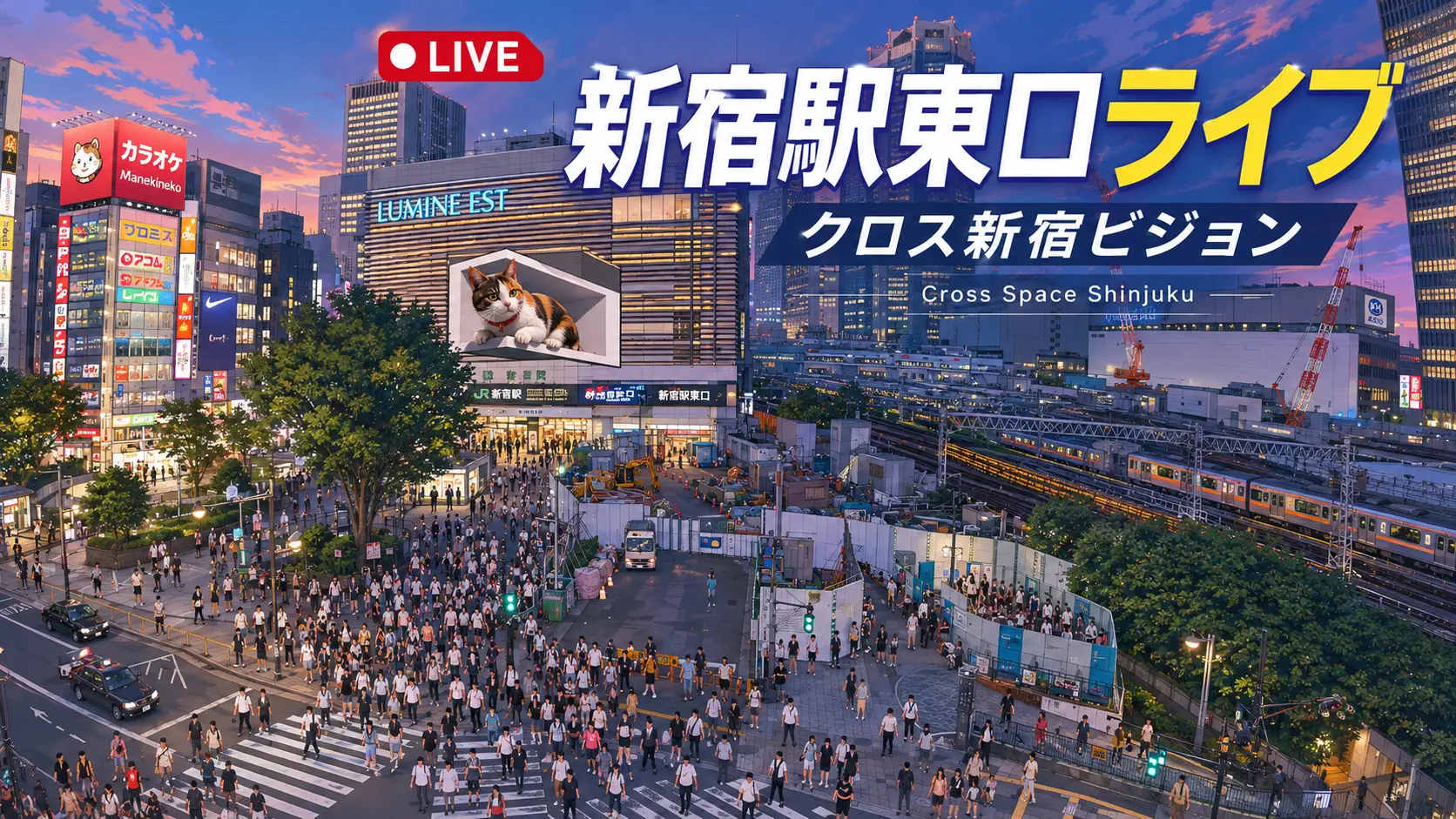
Expand Tokyo comparison set: Cross Space Shinjuku, Shibuya Crossing, Seibu-Shinjuku Station, plus Shinjuku JR live view for platform context. Four cameras, one ward, four grammars of crowd.
On the ground, pair with Shinjuku Gyoen, Tokyo Metropolitan Government Building free observatories, Golden Gai (quiet hours respect), and Omoide Yokocho yakitori alleys west of JR — daytime balance to Kabukicho night.
FAQ
Is Kabukicho safe to visit?
Shinjuku is heavily policed and trafficked; normal urban awareness applies — stick to lit main routes, avoid touts pushing unknown venues, respect local guidance. The cam shows public street life, not alley interiors.
How is this different from the Kabukichō Shinjuku street cam?
This camera shows Kabukicho Crossing on Yasukuni-dori from the Teikei building — traffic and intersection focus. The Kabukichō Shinjuku cam faces Ichiban-gai street-level nightlife.
Can I see Shinjuku Station from here?
Not platforms directly — but rail lines toward Seibu-Shinjuku and JR Shinjuku appear in the distance; both stations are short walks away.
When is the best time for neon atmosphere?
After sunset, especially 20:00–23:00 weekends — subject to season and weather; rain amplifies reflections.
Is this family-friendly viewing?
The street crossing view is public urban traffic — suitable for general audiences. Kabukicho alleys contain adult-oriented venues; this cam does not show explicit content, but the district context is nightlife-oriented.
What ward is Kabukicho in?
Shinjuku Ward, Tokyo Metropolis — city label Shinjuku in frontmatter reflects ward usage common in English travel writing.