

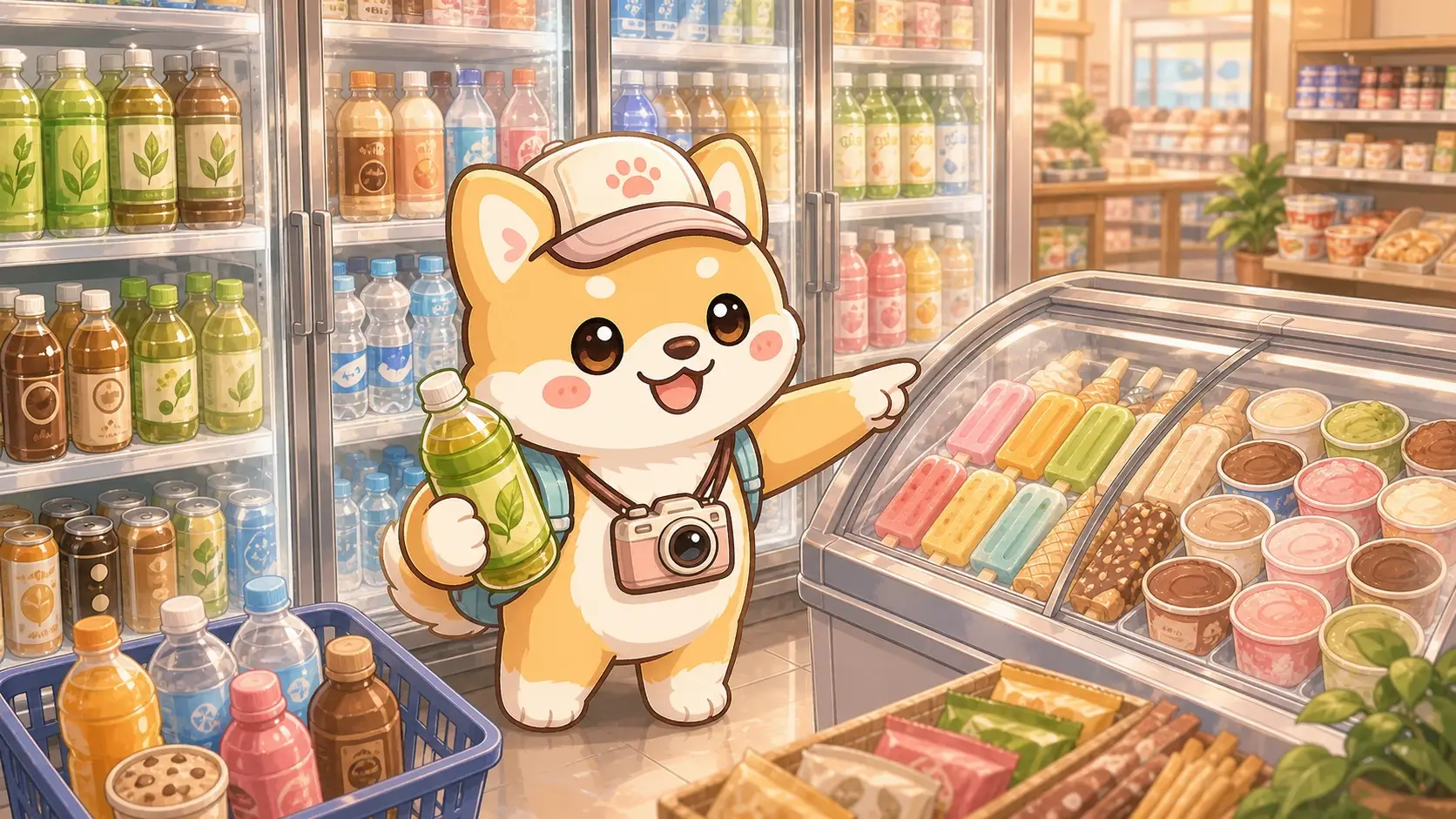
The big kombini article tells you what to eat first. This page is the fridge: japanese convenience store drinks and the freezer next to them. You will open that door more often than the hot case. Tea, canned coffee, milk drinks, and a rotating wall of ice cream are how Japan hydrates between stations.
If you want street machines instead of shop fridges, use the vending machine drinks field guide — tea versus dessert labels are already solved there. This page is what changes when the door is a fridge: private brands, 2L bottles, the in-store coffee machine, and the ice cream freezer. If you want the full food sequence, stay with japanese convenience store food.
Japanese convenience store drinks: how to read the fridge
Japanese convenience store drinks are grouped more honestly than a tourist café menu.
Walk to the cold case first. Then the hot-can case if you want coffee or corn soup. Then the freezer. You do not need a café. You need a basket and two minutes. Prices are on the shelf edge.
Layout is similar across 7-Eleven, FamilyMart, and Lawson, but private-brand drinks differ. If you liked a Lawson milk tea, do not expect the same SKU at 7-Eleven. That is normal.
Unsweetened tea (buy this on purpose)
Green, barley, oolong — same job as the vending wall, more SKUs. Look for bottles that do not show cream. The fridge extra: 2L bottles for a hotel room, and chain private labels that do not exist on the street. Fine if you have a fridge. Stupid if you are walking to a shrine in August.
Sweet tea exists. It is labeled. Health-tea and sesame-barley mixes taste like tea, not juice.
Sweet tea and milk tea
Peach, lemon, royal milk tea. Fine as a treat. A second bottle is how sugar sneaks into a walking day. Iced coffee bottles — black or with milk — are stronger than many US iced coffees. Café au lait is dessert. Fine at 4 p.m., rough as breakfast if you are sensitive to sugar.
Coffee (fridge and machine)
Canned Boss and Georgia live here too. The in-store fresh-brew machine (especially 7-Eleven) is often better. For the heated-can sidewalk ritual, that is the japanese coffee vending machine story. Hot cans in winter — coffee, cocoa, corn potage — live in the hot case, not the cold one.
Milk, fermented, Calpis-style
Calpis water, lactic drinks, coffee milk. Kids’ shelf energy. Useful when tea feels like a lecture. Dilute if you buy concentrate; the canned version is ready.
Sports and soda
Pocari and Aquarius after heat — the japan summer packing list is why you wanted electrolytes in the suitcase and still buy them here. Cola is cola. Ramune is a marble novelty. Alcohol sits in another door; legal age is 20. A quiet can on a hotel balcony is closer to local behavior than chugging on a crossing.
Seasonal limiteds
Sakura cans, autumn sweet potato, winter hot-hold bottles in some shops. One is a souvenir. Four is a suitcase leak.
Pay, walk out, drink outside or at the eat-in corner if the shop has one. Do not hold the fridge door open while you translate every label. The Umineko Shouten in-store camera is the slower rural version of this grab: stock facing the aisle, people already knowing which door.
Tourists stall in the tea door because there are forty greens. Pick one 0 kcal bottle and move. You can try a different brand tomorrow. There will be another 7-Eleven.
Japanese convenience store ice cream
Japanese convenience store ice cream is a serious category, not a sad freezer of three flavors.
You will see:
- Garigari-kun — soda ice pops, loud packaging, cheap, actually good when it is hot
- Mochi ice / yukimi daifuku cousins — rice cake around ice cream; eat fast
- Premium matcha bars — one is enough
- Cookie sandwiches and chocolate-coated
- Regional limited boxes in summer
- Cup ice that beats a tourist café scoop on price
The freezer is a heat strategy in August and a “I already walked 18,000 steps” prize. It is not dinner. Melt on asphalt is instant; eat in shade. A station bench is fine. A moving scramble crossing is not.
Regional ice (Hokkaido milk, Okinawa flavors, local fruit) rotates. If you see a prefecture name, it is usually a limited run. Buy one. You will not find it next week in another city.
If you are combining with japanese convenience store onigiri, do drinks first or the rice gets wet from a sweating bottle in the same bag. Onigiri details live in onigiri fillings.
Japanese convenience store chains: who wins the fridge
Japanese convenience store chains overlap 80% on drinks. The remaining 20% is private-label tea, which ice cream rotator, and whether the coffee machine is worth the extra minute.
- 7-Eleven: the fresh-brew machine people actually queue for.
- Lawson: freezer and sweets; cream puffs steal you from the tea door.
- FamilyMart: a full drink wall; fried chicken is a food argument, not a hydration one — that lives in the japanese convenience store food sequence.
Do not tour all three for tea science. The nearest door wins. Street machines along Koen Dori duplicate brands at a slight convenience tax. Shop fridge wins on choice. Machine wins on not entering.
A cheap drinks-and-ice pattern
- Morning: machine coffee or unsweetened tea
- Midday walk: tea bottle
- Heat spike: Pocari or ice pop, not both
- Night: nothing, or one milk tea if dinner was salty
That pattern costs little and does not wreck the food budget in the average trip cost sheet.
Night discount stickers rarely hit drinks. They hit sandwiches. Do not wait for a tea markdown that is not coming.
How to choose fast when you are tired:
- Hydration: unsweetened tea or Pocari.
- Caffeine: black iced coffee or hot can.
- Treat: milk tea or ice cream, not both unless you like regret.
- Pay. Leave. Drink outside or in the hotel.
What not to do in the fridge aisle
- Do not buy six limited cans “for friends” until you have weighed your bag.
- Do not microwave ice cream.
- Do not assume “tea” is unsweetened.
- Do not block the door at 8:00 a.m. commuter peak.
Pay with IC or cash. Walk. Recycle if you see a ペット / 缶 bin; otherwise carry it to the hotel. The in-store coffee machine is already in the coffee subsection — do not treat it as a fourth decision at the door.
FAQ
What should I drink every day?
Unsweetened tea. Then coffee if you want the ritual.
Is kombini coffee better than vending cans?
Often the fresh machine, yes. Cans win on location.
Which ice cream should I try first?
Garigari-kun if it is hot. Matcha bar if it is not.
Can I live on drinks and onigiri?
For a transit day, yes. For a week, add a hot meal.
Do all chains have the same tea?
Mostly. Labels rotate. The category stays.
Is ice cream expensive?
Pops are cheap. Premium bars add up if you “just look.”

