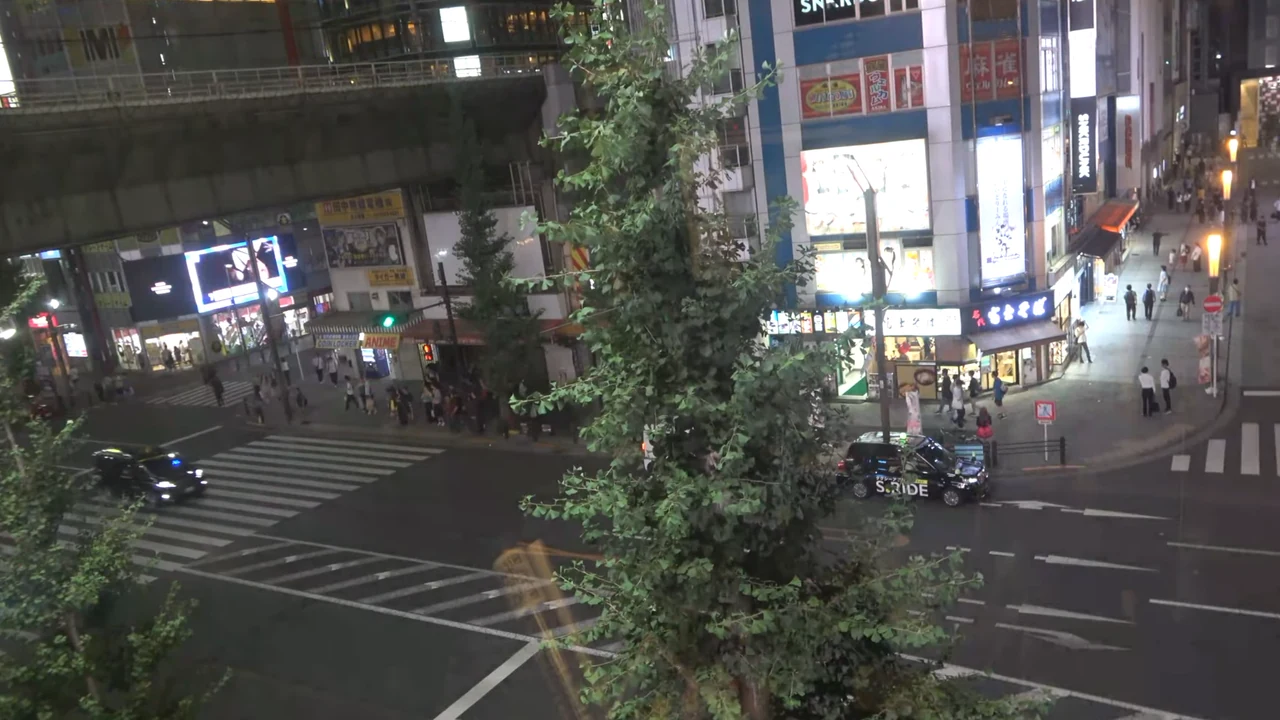

From a rooftop in Nishiazabu, Tokyo does not whisper — it performs. The live camera looks toward Roppongi (六本木), one of Minato Ward’s most internationally known districts, and frames a scene that is unmistakably central Tokyo: elevated expressway traffic threading past mid-rise blocks, office towers catching the last light, and on clear evenings Tokyo Tower rising on the right like a red-and-white exclamation mark against the sky. This is not a postcard angle from a observation deck. It is a working urban vista — the kind locals see from apartment balconies and hotel terraces while deciding whether tonight is a quiet dinner in Azabu or a late one in Roppongi.
About This Live Camera
The stream is positioned in Nishiazabu, the refined residential and dining quarter immediately west of Roppongi’s main entertainment spine. The lens faces roughly toward Roppongi and captures the Shuto Expressway Shibuya Route (首都高速3号渋谷線, Route 3 of the metropolitan expressway system) as it runs above Roppongi-dōri and nearby arterials. Tokyo Tower appears on the right side of the frame when visibility allows — especially striking after dusk when its illumination program turns the steel lattice into a lantern visible across much of the city.
Expect an HD city-and-traffic composition rather than street-level pedestrian detail. Vehicle flow, weather, and the tower’s lighting are the main variables. Stream availability may vary by broadcaster schedule; treat “live” as an invitation to look rather than a guarantee of continuous uptime.
What You Can See
On a clear day, read the frame in layers. Foreground and midground show the expressway’s elevated deck — cars and trucks moving in pulses tied to rush hours and weekend nightlife departures. Beyond the road, Minato’s mixed skyline combines office blocks, residential towers, and the occasional construction crane. Tokyo Tower, completed in 1958 at 333 metres, dominates the right horizon; its main deck sits at 150 metres and the special deck at 250 metres. At night, seasonal lighting themes — warm orange on ordinary evenings, occasional special colour schemes — make the tower the emotional anchor of the view.
You will not see individual nightclub queues or museum interiors from this height, but you can infer the district’s rhythm: heavier southbound traffic late at night, brighter glow from Roppongi Hills and Tokyo Midtown complexes on the horizon, and sudden rain turning the expressway into a ribbon of reflected headlights. On rare winter mornings with strong northwesterly winds, distant peaks may ghost the horizon — a reminder that Tokyo sits in a basin ringed by mountains.
Location
Roppongi occupies the southern portion of Minato Ward, between Akasaka to the north and Azabu to the south, roughly 3 km southwest of Tokyo Station. Nishiazabu sits on its western flank — quieter streets, embassies, creative agencies, and high-end dining rather than the densest club strip. The camera coordinates place it in this transition zone where residential calm meets international nightlife.
The Shuto Expressway Route 3 (Shibuya Route) visible in frame is an 11.7 km elevated radial that connects the Inner Circular Route near Tanimachi Junction toward the Tōmei Expressway in Setagaya. The section passing Roppongi opened in stages from 1964 — timed with Olympic-era infrastructure — and remains one of the city’s busiest elevated corridors. Tokyo Tower stands in Shiba-koen, about 2 km southeast as the crow flies — close enough for a ¥1,000 taxi ride from Roppongi, yet far enough that this camera treats it as a skyline companion rather than a neighbour.
History
The name Roppongi — “six trees” — dates to the 1660s, when six large zelkova trees reportedly marked the area. During the Edo period, the district remained largely quiet until the Meiji Restoration brought military facilities and growing traffic. In 1890, the Third Imperial Guard established a presence nearby; soldiers’ demand for entertainment seeded the nightlife reputation that never quite left. After World War II, U.S. military personnel concentrated in the area, and Japanese-owned bars, restaurants, and clubs multiplied to serve an international clientele — a pattern that shaped Roppongi’s bilingual, expatriate-friendly character for decades.
Nishiazabu developed as a more residential counterweight — low-rise charm, foreign embassies, and later creative-industry offices including Google Japan, Yahoo! Japan, Pokémon Company, and Ferrari Japan headquarters in the broader Roppongi-Akasaka zone. The 2003 opening of Roppongi Hills (Mori Tower at 238 metres) and 2007 completion of Tokyo Midtown reframed the district: world-class museums, luxury retail, and curated public art alongside the older bar culture. Tokyo Tower, built as a broadcast and symbol tower in 1958, predates both complexes yet remains the most emotionally legible landmark in this camera’s view — a Showa-era icon still competing with Tokyo Skytree for affection.
The expressway below is younger than the tower but older than the mega-developments — post-war infrastructure that literally stacked transport above a district already famous for stacking cultures.
Why Watch
Because Roppongi is Tokyo’s most argued-about neighbourhood — business district by day, pleasure district by night — and this camera shows the infrastructure that keeps both sides supplied. Because Tokyo Tower at night from a distance is one of Japan’s great free spectacles, and this feed delivers it without a ticket queue. Because elevated expressway traffic is oddly hypnotic: a real-time stress map of who is leaving the city core and when.
Urban planners watch for congestion patterns. Travelers use the view for weather and visibility before walking to Mori Art Museum or 21_21 DESIGN SIGHT. Homesick Tokyoites leave it open while cooking abroad, listening to the silent flow of headlights. It is Minato without the nightclub cover charge.
Daily Life
Weekday mornings bring office workers toward Roppongi-itchōme and Nogizaka stations; expressway volume builds from 7 a.m. Midday is calmer — lunch meetings in Hills and Midtown, embassy errands in Nishiazabu. Evening splits the district: art-gallery openings and rooftop bars versus the louder Roppongi crossing scene a few blocks east. After midnight, traffic patterns shift again as clubs release their crowds and taxis multiply.
Nishiazabu residents experience Roppongi as noise at the edge of sleep — the camera’s altitude softens that tension into a panorama. Delivery trucks, film crews, and seasonal illuminations along Keyakizaka (in Hills, off-frame but culturally nearby) punctuate the year. This is not a residential street camera; it is a district-scale pulse monitor.
Best Time of Day to Watch
- Blue hour (roughly 17:00–19:00 JST): Tokyo Tower illumination against a deepening sky — the view’s signature moment.
- Rush hours (7:30–9:30 and 17:30–20:00): expressway traffic density peaks; good for urban-energy watching.
- Clear winter mornings: sharper air, stronger tower visibility, occasional mountain silhouettes.
- Late night (after 23:00): lighter traffic, brighter tower glow, fewer construction distractions.
- Rainy evenings: reflective road surfaces and smeared city lights — moody, cinematic.
Best Seasons and Weather
Winter offers the clearest sightlines to Tokyo Tower and distant topography. Spring brings mild haze and cherry blossoms in neighbourhood parks you cannot see but can infer from weekend traffic toward Aoyama. Rainy season (June–July) reduces visibility yet increases dramatic cloud stacks. Summer haze and heat shimmer soften the tower’s outline; Bon and Obon travel weeks alter traffic. Autumn nights are crisp — ideal for tower photography by proxy. Typhoon approaches show up as emptying roads and racing clouds long before wind hits the microphone-free feed.
Events and Celebrations
Roppongi Art Night and gallery district openings cluster in spring and autumn — not always visible here, but traffic swells on event weekends. Tokyo Tower runs seasonal light-ups: New Year, Christmas, Tanabata, and charity colour campaigns — check the tower’s schedule and watch the cam at switch-on time. Hills/Midtown winter illuminations draw crowds that ripple into expressway volume. National holidays and Golden Week produce distinctive midday congestion patterns. Formula 1 or major sports nights rarely touch this frame directly, yet concert evenings at Tokyo Dome-scale venues sometimes echo in late-night traffic lulls.
Getting There
Roppongi Station serves Tokyo Metro Hibiya Line and Toei Ōedo Line. Nogizaka (Chiyoda Line) and Roppongi-itchōme (Namboku Line) flank the district. From Shibuya, the ride is about 10 minutes. Nishiazabu is walkable from all three — follow Roppongi-dōri west into quieter streets. The expressway has no pedestrian access; this camera’s road is for watching, not walking.
From Haneda Airport, Monorail + Metro or Airport Limousine Bus reach Roppongi in roughly 30–45 minutes depending on mode. Tokyo Tower is a short taxi or 20-minute walk south through Shiba-koen park from central Roppongi.
Interesting Facts
- Roppongi means “six trees,” yet the district is now defined by steel, glass, and neon rather than zelkova groves.
- Tokyo Tower is 13 metres taller than the Eiffel Tower it references — a deliberate Showa-era statement.
- Route 3’s 1964 opening section used construction methods later scrutinised after the 1995 Hanshin earthquake — the expressway you see is living infrastructure history.
- More than 40 embassies operate in Minato Ward; several lie within walking distance of this vantage.
- Roppongi Hills alone contains a Mori Art Museum, Tokyo City View observatory, Ark Hills links, and a Toho Cinemas flagship — a city-within-a-city off the right edge of frame.
- Google Japan and Pokémon Company headquarters anchor the district’s shift from military bars to creative-economy HQs.
Tokyo After Dark, From a Distance
Night watching here is a lesson in layered illumination. Tokyo Tower cycles through programmes — some nights warm amber, others themed for causes or seasons — while office floors in mid-rise blocks wink out floor by floor as overtime ends. Expressway lighting turns the deck into a continuous orange thread; vehicle headlights become data points you can almost count. Unlike street-level Roppongi cams that show club queues and neon signs, this elevated view lets you appreciate how carefully Tokyo curates its skyline glow: bright enough to feel safe, restrained enough to sleep nearby in Nishiazabu.
If you have never stood at the Roppongi crossing after midnight, this feed is the diplomatic briefing — energy without noise, motion without crowds.
Reading Traffic as Weather
Before checking a forecast, glance at the expressway. Stationary lanes during a weekday morning mean accidents or Olympic-level events upstream. Unusually light traffic on a Friday night might indicate typhoon warnings or a holiday exodus. Sudden brake-light rivers in rain tell you umbrellas will be mandatory on the ground. The tower disappearing into cloud while traffic flows normally is classic June humid haze; the tower sharp as a needle on a windy December dawn means bring a coat to any rooftop bar you are planning. The camera teaches Tokyo’s atmosphere through infrastructure — a skill worth having before you visit.
Nearby Live Cameras
Compare tower perspectives on Tokyo Tower View, trace more expressway drama on the Metropolitan Expressway feed, or shift to waterfront scale at Odaiba Tokyo Bay.
Frequently Asked Questions
Can I see Tokyo Tower clearly on this camera?
On clear days and evenings, yes — the tower appears on the right side of the frame and is especially photogenic after dark when illuminated.
Is this camera in Roppongi or Nishiazabu?
The broadcast originates from Nishiazabu, looking toward Roppongi — the adjacent, slightly quieter district west of the main nightlife strip.
What is the Shuto Expressway in the view?
It is Route 3 (Shibuya Route) of the Shuto Expressway — an elevated toll road carrying radial traffic through Minato toward Shibuya and beyond.
Is the stream available 24/7?
Broadcasting may follow operator schedules; uptime is not guaranteed around the clock despite the “live” status.
Why is Roppongi famous internationally?
Post-war U.S. military presence, decades of expatriate nightlife, and later Roppongi Hills / Tokyo Midtown culture complexes made it one of Tokyo’s best-known foreigner-friendly districts.
How far is Tokyo Tower from Roppongi?
About 2 km — roughly ¥1,000 by taxi or a 20-minute walk through Shiba-koen from central Roppongi.
What landmarks are near but not visible?
Roppongi Hills, Tokyo Midtown, National Art Center Tokyo, and the densest club streets lie near the camera axis but below or outside the frame.