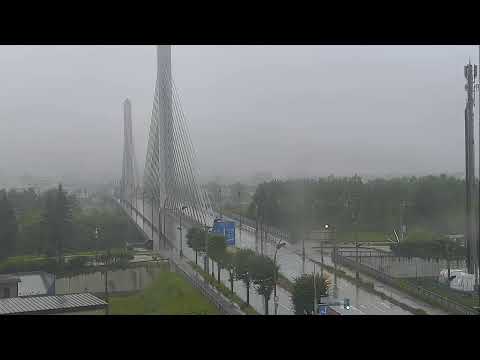

Hokkaido’s Tokachi Plain is big-sky country — fields of sugar beet, wheat, and potatoes rolling toward volcanoes you can name on clear days. The Tokachi River (十勝川) cuts through that agriculture like a slow, brown artery, and the Tokachi Chuo Bridge (十勝中央大橋) — affectionately Hakucho Bridge (白鳥大橋, “Swan Bridge”) — spans it between Otofuke and Makubetsu, east of Obihiro. This live camera from Tokachi Mainichi News (十勝毎日新聞, Kachimai) sits on the rooftop of Tokachigawa Onsen Dai-Ichi Hotel, streaming 24 hours via YouTube ( MXabd7Nac7E ) with the bridge, riverbanks, farm roads, and often whooper swans in winter. You are not in Sapporo’s nightlife. You are in eastern Hokkaido’s honest landscape — where river level matters, snow arrives in metres, and a bridge nickname tells you more about wildlife than engineering specs.
About This Live Camera
The Tokachigawa Hakucho Bridge Live Camera (十勝川白鳥大橋ライブカメラ) has broadcast since October 2014, operated by Kachimai Digital Media Lab with camera hardware on Tokachigawa Onsen Dai-Ichi Hotel, 12-1 Tokachigawa Onsen Minami, Otofuke. The view emphasizes the Tokachi Chuo Bridge cable-stayed span, Tokachi River waters, confluence areas near the Men River, and the Tokachi Central Farm Road — a regional agricultural transport axis.
The stream is 365-day, 24-hour YouTube video, intended for disaster prevention, traffic awareness, and tourism promotion. Network congestion can stall the feed — Kachimai notes non-dedicated uplink limitations — but the source aims for continuous service. Altitude at the camera is roughly 27 m above sea level.
Do not confuse this bridge with Tokachi Ohashi Bridge (十勝大橋) west of Obihiro — a separate, larger crossing on National Route 241 between Otofuke and Obihiro with its own live cameras. This feed watches the Chuo (“Central”) bridge near Tokachigawa Onsen hot-spring resort.
What You Can See
The Tokachi Chuo Bridge stretches 772.5 metres as a PC cable-stayed bridge — elegant white pylons and fan cable arrays over wide riverbed. The river itself carries glacial silt — typical brown-grey Tokachi colour, not alpine turquoise. Green riverbanks and agricultural plots fill the middle distance; on clear days Obihiro and Makubetsu urban edges appear on horizons.
Winter (November–March): whooper swans (Cygnus cygnus) gather on unfrozen river sections — the bridge’s nickname references both swans and cable arrays resembling wings. Steam may rise from onsen district buildings below the camera. Snow covers fields and bridge deck edges.
Spring: meltwater raises river levels — watch colour and speed changes. Summer: lush crops, long daylight, occasional fireworks haze from festivals. Autumn: harvest activity, morning fog in valleys, foliage along riparian trees.
Traffic on the bridge is moderate compared to Tokachi Ohashi — this route connects Prefectural Route 73 toward Tokachigawa Onsen and National Route 38 toward Makubetsu, not the heaviest Obihiro commuter corridor.
Location
Otofuke (音更町) is a town in Kato District, eastern Hokkaido, part of the Tokachi Subprefecture. Obihiro (帯広市), the subprefecture’s core city, lies about 10 km west. Makubetsu (幕別町) sits across the river to the east. The Tokachigawa Onsen resort area — famous for brown moor hot springs (moor onsen) — clusters south of the bridge on the Otofuke side.
The Tokachi Plain is one of Japan’s premier field-crop regions: wheat, beans, sugar beet, potatoes. Daisetsuzan volcanic peaks loom north-west on clear days; Mount Tokachi group southward. The river drains toward the Pacific — flood management is existential for farms.
Camera coordinates (42.932°N, 143.293°E) place the viewpoint at the onsen hotel rooftop overlooking the bridge’s Otofuke-side approach.
History
Bridges over the Tokachi River multiplied as Hokkaido’s interior opened to Meiji-era settlement — colonists converting wetland and forest to farmland. The current Tokachi Chuo Bridge replaced earlier crossings to serve Tokachi Central Farm Road development and onsen tourism growth in the late 20th century.
Tokachigawa Onsen developed from discovered springs in the Taisho era, marketed for medicinal moor water rich in organic humus — unusual among Japanese hot springs. Hotels including Dai-Ichi expanded mid-century as rail and bus access improved from Obihiro.
Kachimai launched regional live cameras in the 2010s — this 2014 installation joined feeds for JR Obihiro Station, Tokachi-Obihiro Airport, and Tokachi Ohashi — a digital civic network for flood season. Eastern Hokkaido rivers killed before cameras existed; now farmers check YouTube before bed during typhoon remnants.
The Swan Bridge nickname stuck because whooper swans overwinter here and because cable-stayed pylons evoke wings — rare poetic naming for civil engineering.
Why Watch
Because Tokachi is Hokkaido agriculture — the camera shows the plain’s scale better than any map.
Because swan season turns a traffic cam into wildlife TV — thousands of birds without leaving your desk.
Because river flood watching is culturally serious here — the same feed locals use during heavy rain and spring melt.
Because moor onsen steam plus snow plus swans is a visual combination unique to this latitude.
Daily Life
Dawn brings farm vehicles on farm roads — not always on the bridge but visible in wider angles. Onsen guests stroll riverbanks in yukata during summer evenings. Delivery trucks serve hotels; tourist buses pause at Tokachigawa Onsen stops. Winter attracts swan photographers with tripods — parking areas fill on weekends.
Fishermen appear seasonally where regulations allow; Tokachi River has salmon runs though this stretch is managed heavily. Maintenance crews clear snow from bridge walkways in winter — watch for orange vest activity.
Best Time of Day
- Sunrise: fog in river valley; swans active in winter mornings.
- Midday: clearest long views toward Obihiro and Makubetsu skylines.
- Sunset: warm light on bridge cables — photographers’ favourite.
- Night: bridge light-up illuminates white pylons against dark water — onsen evening atmosphere.
Best Seasons
Winter: peak swan presence (roughly November–March); snow scenery; onsen peak season. Spring: high water from melt — monitor river speed and colour. Summer: green monotony broken by flower plantings near hotels; festival weekends. Autumn: harvest dust, crisp visibility, fewer tourists than winter onsen season.
Events
Tokachigawa Onsen winter illuminations and swan festivals draw regional visitors. Obihiro hosts Ban-ei tokachi horse races (draft-horse pulling) — unique Hokkaido sport — swelling hotel occupancy indirectly. Golden Week and Obon boost onsen bookings. Typhoon remnants (September) and Pacific low-pressure systems trigger flood watches — camera traffic spikes locally during those weeks.
Getting There
JR Obihiro Station to Tokachigawa Onsen by bus or taxi — about 20–30 minutes. Tokachi-Obihiro Airport serves flights from Tokyo Haneda and other hubs — 30–40 minutes by car to the onsen area. Driving from Sapporo takes 3+ hours via Doto Expressway.
The camera needs no travel — but visitors staying at Dai-Ichi Hotel literally sleep beneath the same viewpoint.
Interesting Facts
- Bridge length 772.5 m — cable-stayed PC bridge on Tokachi Central Farm Road.
- Nickname Hakucho Bridge for whooper swans and wing-like cables.
- Tokachigawa Onsen water is brown moor spring — unusual acidic-organic profile prized for skin bathing.
- Kachimai has streamed this view since October 2014 — among Japan’s early regional newspaper YouTube live cameras.
- Tokachi Ohashi nearby carries ~35,000 vehicles daily — much heavier than Chuo Bridge traffic.
- Obihiro is famous for sweet potatoes, Tokachi wine, and cheese — dairy country surrounds the river plain.
- Camera elevation ~27 m — enough to read river width, not mountain panorama.
River Levels and Hokkaido Weather
Treat the feed as a hydrology dashboard. Brown water accelerating with debris lines suggests upstream rain — common during typhoon tails. Static wide riverbed with braided channels may indicate low season flow. Ice edges in winter constrain swans to open patches — watch where birds cluster; that open water is thermally or hydraulically significant.
Snow on bridge deck without ploughs implies road closure or early morning before maintenance. Summer heat shimmer over asphalt farm roads distort distant Makubetsu — not camera failure.
Pair watching with official Hokkaido Development Bureau river cameras downstream for multi-point confirmation during flood alerts.
Swan Season Wildlife Watching
Whooper swans migrate from Siberia — arrival builds from late October, peak January–February, departure by March. Morning light shows birds preening on sandbars; sudden collective flight is spectacular on live video.
Do not confuse domestic ducks or gulls with swans — swans are massive, white, and vocal. Photographers sometimes use remote triggers from hotel rooms — you have the same advantage digitally.
Spring migration north happens quickly — one week the frame is white with birds, the next nearly empty. Timing visits (physical or virtual) matters.
Nearby Live Cameras
Compare heavier traffic on Tokachi Ohashi Bridge between Otofuke and Obihiro. Watch rail rhythm at Obihiro Railway Station. See air arrivals at Tokachi-Obihiro Airport.
Frequently Asked Questions
What bridge does this camera show?
The Tokachi Chuo Bridge (十勝中央大橋) — also called Hakucho Bridge (Swan Bridge) — not Tokachi Ohashi Bridge.
Where is the camera mounted?
On the rooftop of Tokachigawa Onsen Dai-Ichi Hotel in Otofuke, operated by Tokachi Mainichi News.
Is the stream 24/7?
Yes — Kachimai targets continuous 365-day YouTube delivery; network issues may cause brief outages.
What is the YouTube video ID?
MXabd7Nac7E.
When can I see swans?
Typically November through March — whooper swans overwinter on open river sections.
Is this in Obihiro city?
The camera is in Otofuke town at Tokachigawa Onsen, about 10 km east of central Obihiro.
Why is the river brown?
Tokachi River carries volcanic and moorland sediment — normal glacial and agricultural runoff colour, not pollution indicator alone.
How is this different from Tokachi Ohashi Bridge?
Tokachi Ohashi is the major Route 241 crossing west of Obihiro with higher traffic. Tokachi Chuo Bridge serves the onsen and farm-road corridor east of Obihiro with swan tourism fame.