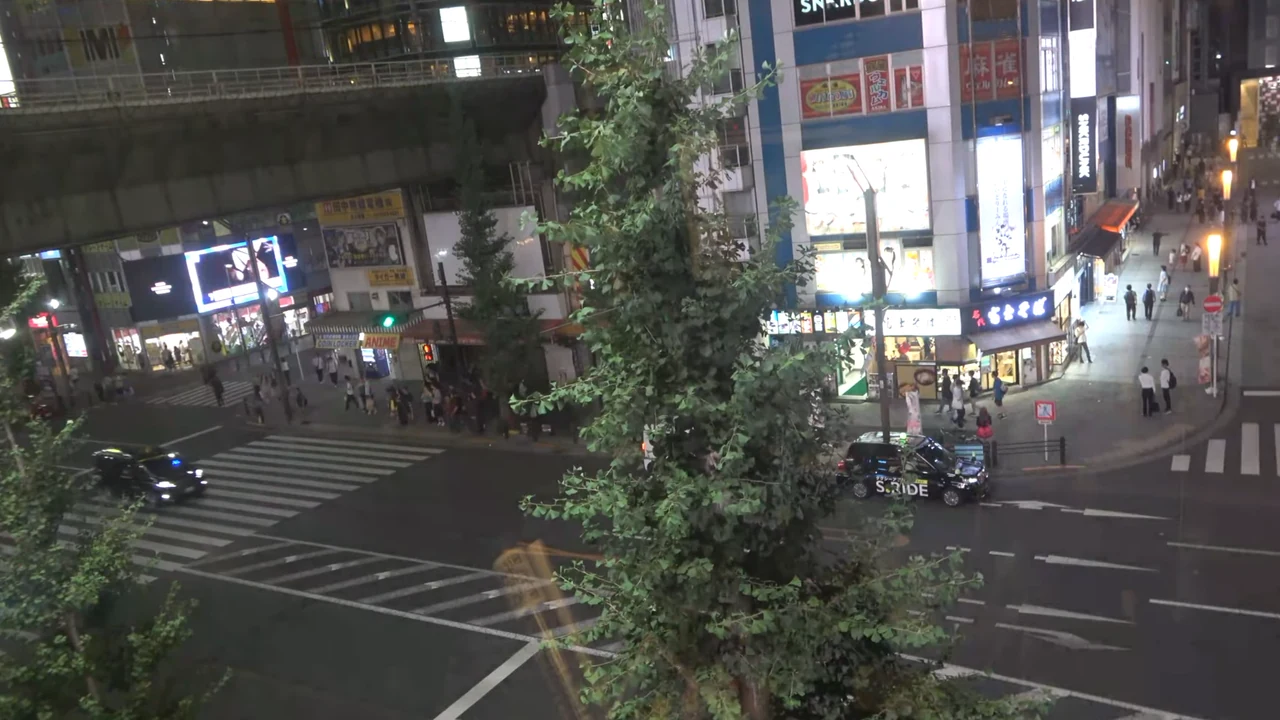

Few airports sit close enough to downtown that you can order ramen after landing and be slurping within half an hour. Fukuoka Airport (FUK) is that rare urban creature — runways almost touching Hakata’s residential fabric, a subway ride of minutes to the Tenjin core, and traffic volumes that long made it Japan’s busiest single-runway airport until a second runway opened in March 2025. This live camera watches the approach and departure corridor where that proximity becomes visible: low passes, tight timing, and the ballet of an airport squeezed between mountains, city, and sea.
About This Live Camera
The feed comes from a YouTube channel embedding a persistent view toward Fukuoka Airport’s runways (channel-based live stream; video ID resolves dynamically — currently cTD7nITGhE0). Alternate aviation portals also host FUK feeds, but this is the primary linked source. Quality varies with encoder settings; daytime offers the clearest landing and takeoff observation, while night shots glow with runway edge lights and arrival strobes.
Because FUK operates under a local noise curfew (flights generally prohibited 22:00–07:00), the camera goes quiet overnight — not a glitch, but policy. Expect bursts of activity in morning banks, midday lulls, and evening peaks before shutdown.
What You Can See
Commercial jet landings and takeoffs dominate: ANA, JAL, Peach, Jetstar Japan, Skymark, and international carriers using FUK’s growing overseas network. The Haneda–Fukuoka route ranks among the world’s busiest air corridors by seat capacity — some days you will see sequential narrowbodies separated by minutes.
Background context includes Hakata Bay haze, residential rooftops, and hillside greenery beyond the runway thresholds. On clear winter days Mount Sefuri and northern Kyushu ridges frame aircraft silhouettes. Ground vehicles — tugs, buses, fire trucks — occasionally cross taxiways in the distance depending on zoom and angle.
Location
Fukuoka Airport lies in Hakata Ward, Fukuoka City, Fukuoka Prefecture, on Kyushu’s north coast facing the Genkai Sea. The domestic terminal sits roughly 5 km east of Hakata Station; the international terminal is farther west (~2.5 km separation) with a free shuttle bus loop.
The camera position is outside secure areas — a rooftop or hillside vantage common among Japanese airport enthusiast streams — looking toward the primary 16L/34R runway (2,800 m). A second parallel runway (16R/34L, 2,500 m) entered service in 2025, initially emphasizing international departures; proximity rules prevent simultaneous dual-runway operations, so the visual drama of congestion may slowly evolve rather than disappear.
History
Aviation here began as Mushiroda Airfield in the 1940s, evolving into a civilian gateway as Fukuoka rebuilt postwar. International terminal expansion in 1999 signaled ambitions beyond domestic shuttles. Low-cost carrier growth after 2012 pushed movements past 145,000 annual slots, triggering Level 3 congestion designation — rare strictness for a regional hub.
For decades FUK’s story was one runway, immense demand: over 26 million passengers in recent years (fourth in Japan after Haneda, Narita, Kansai). Noise complaints from adjacent neighborhoods shaped the 22:00 curfew — watching the last departures race sunset is part of the camera’s narrative tension. March 2025 added the second runway, a ¥180-billion-class national–local infrastructure bet that Kyushu’s economic center deserves capacity closer to Tokyo’s convenience.
Why Watch
Because urban landings are inherently dramatic — aircraft appear to scrape apartment balconies before touchdown. Because FUK is the front door to Kyushu: compare this feed with Hakata Station Square and you see air-rail substitution in real time. Because plane-spotters use FUK to study 737 and A320 family density without trekking to Narita’s sprawl.
Business travelers watch for delay patterns; enthusiasts watch for liveries; storm chasers watch for crosswind landings when typhoon outer bands glance Fukuoka.
Daily Life
Airport-adjacent neighborhoods live with scheduled noise — morning roar becomes background until it stops at curfew. Fishing boats still work Hakata Bay; office workers commute via Fukuoka City Subway Kuko Line (Airport Line) from Gion, Tenjin, and Hakata. Cargo movements include fresh seafood and semiconductor-related freight tied to Kyushu industry.
Inside the fence, ground crews turn narrowbodies with Shinkansen-like precision because slot minutes are scarce. Late evening feels like a countdown show as the last flights scramble before 22:00.
Best Time of Day
- 07:00–09:00: post-curfew departure rush; crisp winter light
- 10:00–16:00: steady mixed traffic; best for photography
- 18:00–21:30: evening arrivals plus sunset color; emotional peak
- Immediately before 22:00: final movements — spotter candy
Avoid expecting action 22:00–07:00 except rare emergencies or approved exceptions.
Best Seasons
Winter brings stable visibility and strong crosswinds occasionally. Summer haze softens backgrounds; typhoon season (Aug–Oct) produces go-arounds and diversions worth monitoring. Golden Week and Obon inflate passenger loads — shorter gaps between flights. New Year travel peaks in both directions; cherry season is less relevant here than summer festival travel (Hakata Gion Yamakasa aftermath still lingers in city energy).
Events
Fukuoka International Airshow eras aside, everyday events are travel peaks: Golden Week, Silver Week, Obon, New Year. Curfew itself is the daily event — a social contract visible from the camera when engines fade at 22:00. 2025 runway opening ceremonies marked a historical inflection; spotting patterns may shift as international departures use the new strip.
Getting There
Subway: Kuko Line to Fukuoka Airport Station (domestic terminal, ~5 min from Hakata, ~11 min from Tenjin). Bus: multiple city and express routes. Taxi: ~¥1,200–1,800 from Hakata depending on traffic. International terminal: free shuttle bus from domestic side (~10 min).
To approximate the camera vantage (not the terminal), local spotters use public hills or buildings — respect private property and aviation security rules; do not drone near the approach path.
Interesting Facts
- FUK handled about 26.8 million passengers recently — fourth-busiest in Japan.
- The Haneda–Fukuoka route often ranks top three globally by seats per year.
- Single-runway era made FUK the busiest one-runway airport in Japan for years.
- Night curfew: roughly 22:00–07:00 due to neighboring residents.
- Second runway (2025): 2,500 m, parallel but too close for simultaneous ops.
- Domestic vs international terminals are physically separate — plan connection time.
- Fukuoka City claims 2,000+ years of exchange history as a Kyushu gateway — the airport continues that geography.
Curfew as Drama
Treat 21:45–22:00 as a micro-documentary. Controllers, pilots, and ground staff compress choreography because missing curfew means diversion or cancellation — expensive humility. Watch landing lights multiply as banks tighten; then silence. That hush is rare among major Asian airports and defines FUK’s personality as much as any statistic.
If you are learning Japanese aviation policy, the curfew teaches community negotiation louder than any textbook.
Runway Proximity and Urban Life
FUK proves airports need not exurb themselves into farmland. The tradeoff is noise politics and slot scarcity — the camera makes both visible when aircraft fly lower than spectators expect. Residential rooftops remind you that NIMBY is not abstract here; it is balcony laundry drying under approach paths.
Post-2025, watch whether the second runway changes international departure rhythms while domestic traffic still squeezes the legacy strip. Evolution may be subtle day-to-day; years will tell.
Spotter Notes: What to Watch For
Aircraft families repeat: Boeing 737 and Airbus A320/A321 narrowbodies dominate domestic shuttles; A350 and 787 appearances mark longer international segments. Peach and Jetstar Japan liveries add orange and pink punctuation. Go-arounds are rare but teachable — watch for aircraft stabilizing low, then power climbing when crosswind or spacing fails.
Weather signatures: Summer haze shortens visible final approach; winter north winds push landings toward dramatic low angles over rooftops. After typhoon passage, calm skies plus standing water on taxiways produce reflection shots even from distant cams.
Sound (if you open the stream unmuted): engine pitch rises on takeoff roll from the shorter runway perspective; reverse thrust bark on landing carries across residential zones — part of why the curfew exists.
Hakata in the Same Breath
Most FUK passengers become Hakata Station passengers within twenty minutes. The air-rail handoff defines Fukuoka’s competitiveness versus Osaka and Tokyo. Watch a morning bank land here, then switch to Hakata Station Square — you will see the same human wave convert from cabin baggage to shinkansen sprint. That continuity is the city’s economic superpower: Kyushu meetings start before luggage cools.
Nearby Live Cameras
Ground your Kyushu travel hub triangle with Hakata Station Square, Tenjin Watanabe-dori Avenue for downtown street energy, and Oita Airport for a smaller regional counterpart along the same coast.
Frequently Asked Questions
Is Fukuoka Airport still single-runway?
A second runway opened March 2025, but simultaneous dual-runway ops are not allowed due to spacing — many movements still feel like a one-runway airport.
Why does the camera go quiet at night?
Noise curfew (~22:00–07:00) stops most scheduled flights — not a stream failure.
How close is the airport to downtown?
Subway ~5 minutes to Hakata, ~11 to Tenjin — among Japan’s most central major airports.
Can I see international and domestic traffic?
Both use FUK, but terminals are separate; the camera shows runway traffic regardless of terminal origin.
What is the YouTube video ID?
The channel live embed resolves dynamically; current ID cTD7nITGhE0 (verify on watch if the stream resets).
Is FUK bigger than Oita Airport?
Yes — FUK is a national hub (~26M+ passengers); OIT is regional (~1–2M scale). Compare both cams to feel the difference.