

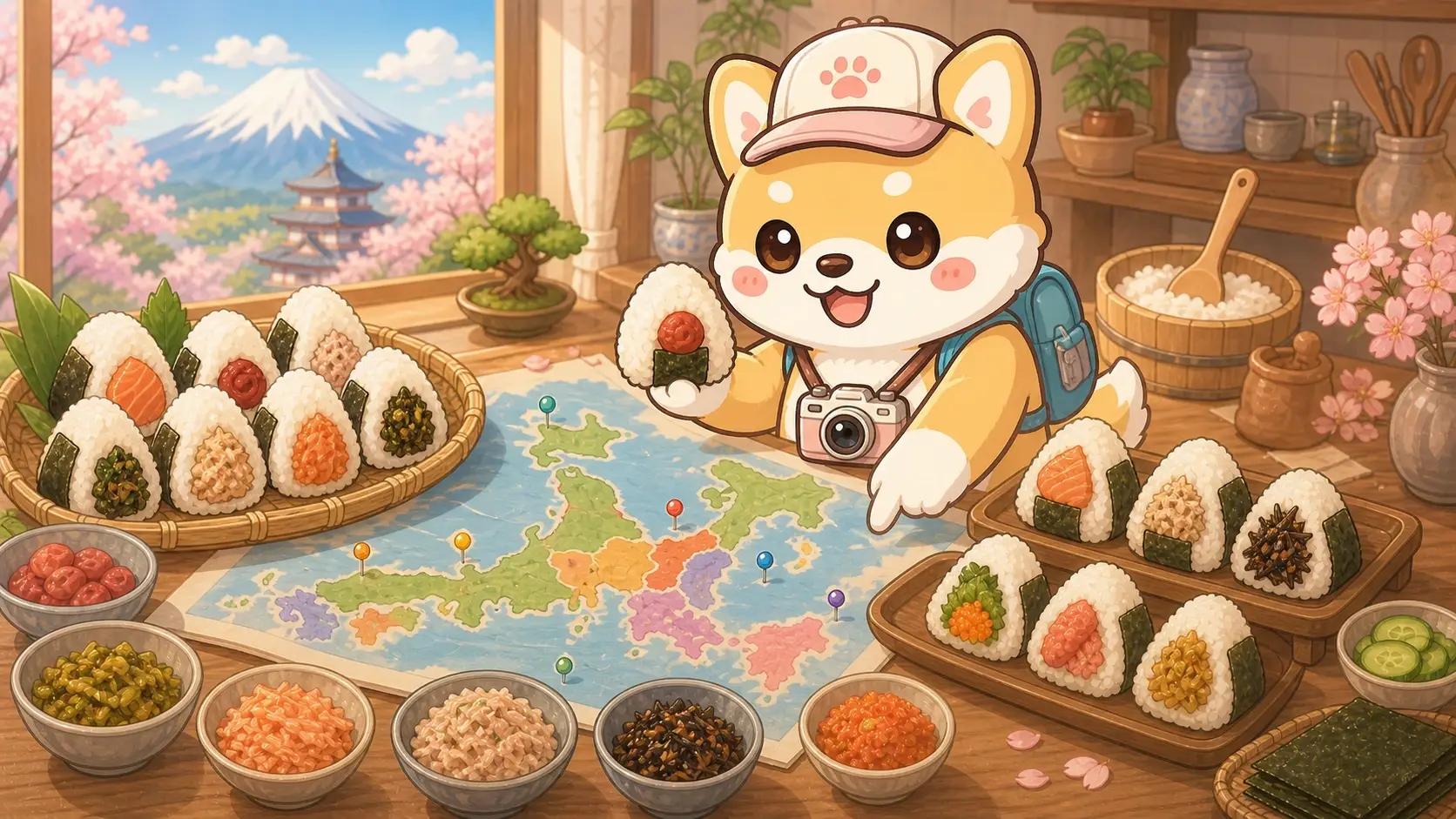
Types of onigiri fillings change when you leave the Tokyo kombini wall. National SKUs are tuna mayo, salmon, ume, and a campaign flavor. Regional SKUs are what the prefecture already puts on rice: takana in Kumamoto, quieter rice in Niigata. This page is geography. The how-to catalog is onigiri fillings.
If you only eat 7-Eleven in Shibuya, you will think Japan has eight fillings. That is the chain’s job. The countryside fridge is the other catalog. Plant-only traps are vegetarian onigiri fillings.
Common onigiri fillings versus regional SKUs
Common onigiri fillings — ume, salmon, tuna mayo, the national eight — are the catalog’s job: onigiri fillings. This page does not re-list them. It is how to tell a national SKU from a prefecture SKU on the same fridge door.
National wrappers repeat in every city because they ship. Regional wrappers say ご当地, name a prefecture, or use a pickle Tokyo only stocks as a limited. You can still buy tuna mayo in Kagoshima. The point of the detour is the one local triangle next to it.
The japanese convenience store food sequence still applies: rice first, then a drink. Here the only question is which triangle is the geography.
Tuna onigiri filling and why it won the country
A tuna onigiri filling in Japan means canned tuna mixed with Japanese mayo, sometimes with cucumber, onion, or a chili line. It is not niçoise. It is not sushi tuna.
Onigiri tuna filling is national industrial food, not a Tokyo secret and not a Kyushu specialty. That is why it sits in every prefecture’s fridge: it ships, it keeps, kids already know it. Chains iterate it (corn, kimchi, basil) without abandoning the base. Taste, assembly, and the mayo clock are in the catalog. Here the point is the map: if you came to a region for “what they actually eat,” tuna mayo is the control sample, not the souvenir.
Onigiri salmon filling versus salmon onigiri filling
Onigiri salmon filling in a shop is usually cooked flakes with salt, sometimes butter or mayo. Salmon onigiri filling is the same object with the words swapped — search boxes do that. It is not raw sake sashimi in the triangle. Raw would be a different product and a worse commute.
Hokkaido and the north make the salmon story feel obvious. You will still find the same flake packet in Okinawa. What changes is quality of the fish in a local shop, not the idea. Convenience salmon is consistent. Station ekiben salmon can be the better version of the same filling — hotter rice, more flake, eaten on the train on purpose.
Filling for onigiri in Kyushu: takana and friends
Filling for onigiri on Kyushu, especially Kumamoto, often means takana — pickled mustard greens, salty, a little heat, a smell you will either want every morning or never again. It is a regional staple that Tokyo treats as a souvenir flavor. If you see it, buy it. You may not see it next week in Shinjuku.
Aso’s landscape does not sell you lunch, but it is the geography the pickle comes from. The Aso Nakadake and Kusasenri live camera is the volcanic plateau; the filling is what people put in rice when they live next to it. Other Kyushu notes: pork miso along some coasts, stronger mentaiko influence from Fukuoka’s fish culture, sweeter soy on simmered kelp in places that cook tsukudani hard.
Do not expect every rural kombini to be a museum of lost fillings. Many stock the national eight plus one local. That one local is the whole point of the detour.
Niigata rice, and why the filling can be quieter
Niigata is a rice prefecture. The triangle can be almost about the grain: a lighter filling, more salt on the rice, a piece of salmon that knows it is supporting. The Shinano River live camera is the water that feeds that agriculture — not a food stall, the reason the onigiri can taste like rice instead of like sauce.
If you grew up thinking onigiri is a delivery system for tuna mayo, Niigata is the correction. Buy the plain salted rice ball once. It is not unfinished. It is the regional thesis.
Station shops near rice country sometimes sell koshihikari labeled triangles that cost more and deserve it. The filling can be ume or nothing. That is still a type.
Other regions, short and honest
- Hokkaido: salmon, butter-corn adjacent experiments, richer dairy in the mayo.
- Tohoku: salmon, pickled greens, conservative kombini walls.
- Kansai: the same national SKUs; the difference is more likely the bread case than the onigiri case.
- Okinawa: pork, spam-adjacent ideas in local shops, still tuna mayo at 7-Eleven.
Airport and Shinkansen ekiben are where regional fillings get packaged for people who will not leave the train. If you only have a transfer in Kumamoto, the platform shop is the regional article in miniature.
For a full cheap Tokyo day that is not regional at all, cheap eats plus two national onigiri is still correct.
How to shop so the regional one is not a trap
Look at the kanji on the wrapper, not the cartoon. If the only English is “spicy” it might be mentaiko, takana, or a chili tuna. When you cannot parse it, ume and salmon remain the safe national pair. Vegetarian travelers still need the label habit — regional simmered kelp can hide fish: vegetarian onigiri fillings.
One regional + one national in the same bag is a good test. If the regional wins, buy it again at the next prefecture’s shop, not in a Tokyo souvenir hall where it has been sitting.
Chopsticks if you bought a packed meal with a pair: chopstick etiquette japan. Most onigiri is still fingers and nori.
A road trip through Kyushu is not required. One night in Kumamoto plus a morning kombini run is enough to taste takana without turning the filling into a scavenger hunt. Niigata can be a Shinkansen stop and a station shop. The cameras on this page are the landscape the rice and pickle come from, not restaurants.
If a wrapper says ご当地 (local) and the filling is still tuna mayo, you bought a local rice, not a local center. Read past the marketing.
FAQ
Is tuna mayo authentic?
Yes, as kombini Japan. Method and keep-times are in onigiri fillings. This page is only why it is national, not Kyushu.
Will I find takana in Tokyo?
Sometimes as a limited. Do not plan a trip around it unless you are already in Kyushu.
Is Niigata onigiri always plain?
No. It is just more likely to let the rice speak. Salmon still sells.
Can I freeze regional onigiri?
Same rule as any triangle: rice texture suffers. See the main catalog.
Are ekiben fillings the same as convenience stores?
Same families, often better rice and a hotter eat. Different price.
What should I buy if I only have one shot?
Salmon or ume if you want Japan-the-textbook. Tuna mayo if you want Japan-the-weekday. Takana if you are in Kumamoto and curious.

