“SHIBUYA PHOTO” was a standing sibch.tv feature: staff who walked Shibuya every day chose one frame from the ward and published it as that day’s dispatch — less essay, more proof that a particular view existed on a particular walk. Issue #029 turned the camera toward Shibuya Public Hall (Shibuya Kōkaidō), a civic building whose rebuild had already been decided when the post went live.
The lead photograph (shibuyaphoto029.jpg, alt text: Shibuya Public Hall) carried most of the meaning then, as now.
What the series format promised
The header stated the premise plainly: sibch.tv picks one image of Shibuya encountered on a daily walk. Each installment named its subject before showing the picture. #029’s label was explicit — the public hall whose demolition timetable was already public knowledge.
That format differed from restaurant reports or exhibition listings elsewhere on the site. SHIBUYA PHOTO entries functioned as a visual index of the ward: one frame, one place name, enough orientation for a reader who might never open a map. When the subject was a building slated for removal, the restraint of the format became part of the message: here is the hall, still standing, still watching the basin below.
The lead photograph and what it anchored
The feature image presented Shibuya Public Hall from the staff’s chosen angle — a composed street photograph rather than a phone snapshot. The original post did not attach a long caption essay to the photo itself; the building’s silhouette on its hill above Park Street (Kōen-dōri) was the editorial point.
For archive readers today, that restraint matters. sibch.tv treated a civic landmark in transition as worth printing even when words stayed short. The hall was not framed as a shopping destination or a concert listing for the coming week. It was framed as architecture that had long occupied a fixed position in Shibuya’s skyline — and was about to leave it.
Olympic history and the concert-hall years
The source text recorded two layers of public memory. In 1964, during the Tokyo Olympics, the hall served as the weightlifting venue — a fact that ties a modest-looking municipal building to one of the ward’s few direct Olympic footprints. After the Games, it continued as a concert hall familiar to local audiences.
That dual biography explains why a demolition notice could read as loss rather than mere urban renewal. The hall was not only a file in a planning document; it was a room where bodies gathered for music after having once gathered for sport at national scale. The SHIBUYA PHOTO post did not rehearse every performance held inside. It named the Olympic weightlifting use and the later concert role — enough to signal that the building’s cultural weight exceeded its footprint on the hill.
Rebuild timeline as reported
When #029 was published, the rebuild was no longer rumor:
- Demolition could come as early as fiscal 2015.
- A new building was planned for fiscal 2018.
- The adjacent ward office was also scheduled for rebuild.
Those dates reflect planning language from the early 2010s, not a guarantee of on-site progress on the day the photo ran. Archive readers should treat them as what sibch.tv recorded at publication time, then verify current status independently. The editorial mood of the piece, however, was clear: the hall’s remaining days were numbered, and the staff wanted readers to look at it while it still stood.
Park Street hill and the view over Shibuya
The original described the hall as having watched over Shibuya for many years from the hill along Park Street. That locational detail is the geographic heart of #029. Shibuya’s famous crossing sits in the basin; the public hall sat above the commercial roar on a ridge associated with the Park Street axis — a different pace and a longer sightline.
SHIBUYA PHOTO did not include a separate map graphic for this installment (unlike some Serena volumes elsewhere in the archive). The hill reference was the orientation note: readers who knew Park Street could place the building; readers who did not still understood that the hall overlooked the district rather than competing with it at street level.
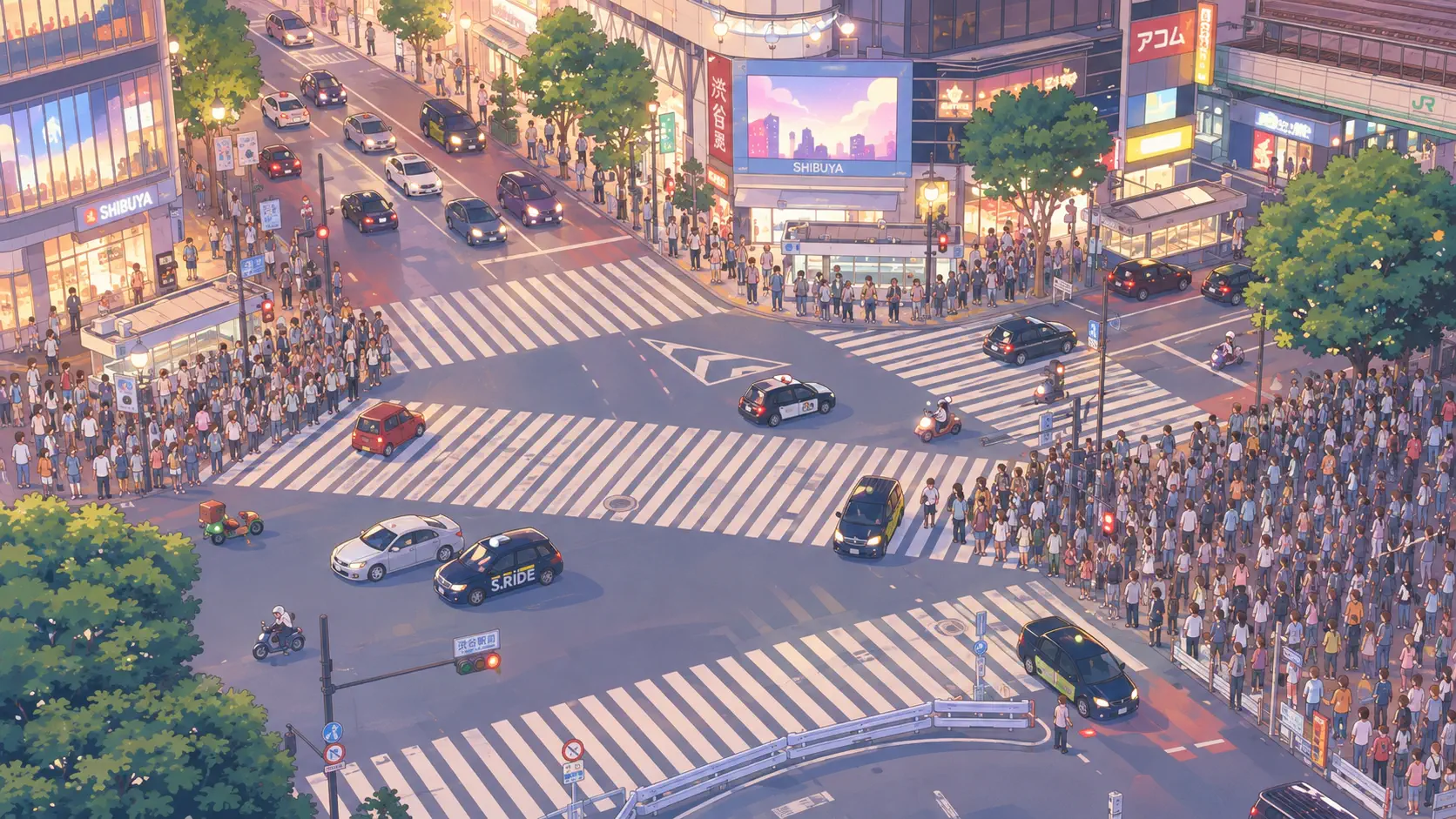
If you watch Shibuya today on a Shibuya Crossing live camera, you are seeing the continuous version of the basin the hall once surveyed from above — pedestrian phases, billboard light, and the hourly fill-and-empty rhythm that makes the ward readable from abroad. #029 asks you to hold that live view alongside a still frame of the civic roofline that used to anchor the northern slope.
Still frames of Public Hall pair with the live basin view explained in how to watch Japan live.
The farewell tone in the original closing
The post ended with an emotional instruction rather than a calendar of final concerts: demolition would be sad, but until that day arrives, the hall should keep watching over Shibuya. That personification — a building tasked with guardianship until its last day — is characteristic of sibch.tv’s softer editorial voice on place pieces. It is not technical planning language. It is a request to notice.
For an archive, preserving that tone matters. Urban redevelopment posts often list floor counts and completion quarters. #029 listed those too, briefly. What readers remembered was the invitation to look up at the hall on the hill one more time while it remained part of the skyline.
Why #029 belongs next to live-camera pages
Scramble crossings and station-front cameras dominate outside perceptions of Shibuya. Civic buildings on Park Street hill participate in a slower layer — municipal memory, Olympic residue, concert audiences — that does not always survive in tourism marketing. A one-photo dispatch with a demolition footnote captures that layer at the moment of transition.
SHIBUYA PHOTO #029 therefore pairs naturally with live views of the crossing basin. The camera below shows motion; the hall above once showed duration. Together they sketch a ward that rebuilds its foreground constantly while retiring fixed landmarks on its slopes.
Key facts from the dispatch
- Series: SHIBUYA PHOTO by sibch.tv, #029
- Subject: Shibuya Public Hall (Shibuya Kōkaidō)
- Asset cited: lead photo
shibuyaphoto029.jpg(alt: Shibuya Public Hall) - 1964 Tokyo Olympics: weightlifting venue
- Later use: concert hall
- Rebuild note: demolition possibly from FY2015; new building planned FY2018; adjacent Shibuya ward office also slated for rebuild
- Location note: hill along Park Street (Kōen-dōri), overlooking Shibuya
Confirm current building status and public access before visiting.