As 2012 drew to a close, Shibuya Channel published a practical map for people planning their first shrine visit of the new year. The piece was not a deep theological tour. It was a neighborhood guide: nine shrines inside or adjacent to the Shibuya ward footprint, each with an address, a phone number where available, a short note on what visitors prayed for, and — where the shrine had published them — concrete New Year schedules for 2013.
Event dates below reflect what was recorded for January 2013. Confirm current hours and ceremonies before visiting.
Why a shrine map belonged on sibch.tv
Hatsumōde is one of the few calendar moments when Tokyo’s entertainment districts briefly share rhythm with older civic life. Shibuya’s brand image runs toward neon, crossing crowds, and late trains — but the ward also holds some of the city’s most visited religious sites, including Meiji Jingu on its western edge. The guide assumed readers might want something quieter than the scramble: a walk with family, friends, or a partner through shrines that feel embedded in residential streets, office corridors, and forest paths rather than on a single tourist strip.
The staff compiled locations onto a Google My Map titled “Shibuya Shrine Map,” centered roughly on 35.667826, 139.700518 at zoom level 14. That map link was the spine of the feature; the prose filled in human-scale detail the pins could not carry.
Meiji Jingu — Japan’s busiest hatsumōde address
Address: 1-1 Yoyogi-Kamizonocho, Shibuya
Phone: 03-3379-5511
Website (historical): http://www.meijijingu.or.jp/
Meiji Jingu claims the largest hatsumōde attendance in Japan. The original piece listed benefits associated with the shrine: household safety, successful romance, business prosperity, and general fortune for organizations and commerce.
For New Year 2013, the article noted overnight worship from Ōmisoka (New Year’s Eve) through New Year’s Day. Detailed gate hours were pointed to the shrine’s own New Year page. Additional January programming included the Meiji Jingu National New Year Calligraphy Exhibition in the shrine corridor (5–30 January), a sumo ring-entering offering by yokozuna on 8 January at 15:00 in front of the main hall, and an ice sculpture exhibition on the main approach on 13–14 January.
Yoyogi Hachimangū — green guardian in the city
Address: 5-1-1 Yoyogi, Shibuya
Phone: 03-3466-2012
Website (historical): http://www.yoyogihachimangu.or.jp/
Described in the original as a lush guardian grove surviving inside the metropolis, Yoyogi Hachimangū was linked to safe childbirth, child-rearing, household peace, and dispelling malignant spirits.
Scheduled events for the season included Ōharae (great purification) on 30 December at 17:00; on New Year’s Eve, amazake and children’s festival music from the parish youth association; a children’s book exhibition from 1–12 January (ending on the morning of the 12th); and New Year prayer reception from midnight on 1 January.
Togo Shrine — Admiral Togo as enshrined kami
Address: 1-5-3 Jingumae, Shibuya
Phone: 03-3403-3591
Website (historical): http://www.togojinja.jp/
Togo Shrine enshrines Marshal-Admiral Togo Heihachiro. The original associated it with victory, career advancement, and general upward fortune.
On 1 January 2013, various prayer services were offered from midnight until 17:00, with “victory amazake” served to visitors.
Smaller neighborhood shrines on the map
The article grouped several compact sites that reward a slower walk away from the station core.
Oyama Inari Shrine (1-7 Shōtō, Shibuya) sits in a quiet Shōtō residential pocket. Prayers were tied to travel safety and business success.
Chiyoda Inari Shrine (2-20-8 Dōgenzaka, Shibuya; 03-3461-9306) stands within the Dōgenzaka “hyakken-gai” shop street. Benefits listed included travel safety and prosperous trade. On New Year’s Day, the shrine planned roughly three hours of ozōni and sacred sake for visitors from midnight.
Mitake Shrine (1-12-16 Shibuya, Shibuya; 03-3407-7722) sits partway up Miyamasuzaka and was noted for rare komainu modeled on Japanese wolves. The original tied it to theft protection and exam success.
Kanō Hachimangū (3-5-12 Shibuya, Shibuya; 03-3407-1811) was described as the birthplace of Shibuya and the chief guardian of Aoyama and Shibuya. Benefits included career fortune and guidance at life’s crossroads. Events: Ōharae on 31 December from 16:00 (open participation; registration from 30 minutes before); ozōni and sacred sake on 1–3 January.
Hōei Inari Shrine (3-4-7 Shibuya, Shibuya; 03-3400-1535), opposite Kanō Hachimangū, was linked to business prosperity and household fortune. Amazake on New Year’s Day.
Hikawa Shrine (2-5-6 Higashi, Shibuya; 03-3407-7534) was called Shibuya’s oldest shrine, with a precinct of about 4,000 tsubo. Benefits included matchmaking, career luck, warding off misfortune, and inviting good fortune. From midnight on New Year’s Day for about two hours, amazake and ozōni were offered; festival music was scheduled during the daytime on New Year’s Day.
A priest’s message from Kanō Hachimangū
The feature closed with cooperation from Kanō Hachimangū’s chief priest, Katsutoshi Tadokoro. His message stressed that connecting with the kami at the year’s beginning brings fortune for the months ahead — and that a bond with the divine connects to other bonds in daily life. He asked readers to treat the first day of the year with care.
The article ended with a wish that 2013 would be a happy year for everyone.
How this fits the wider Shibuya basin
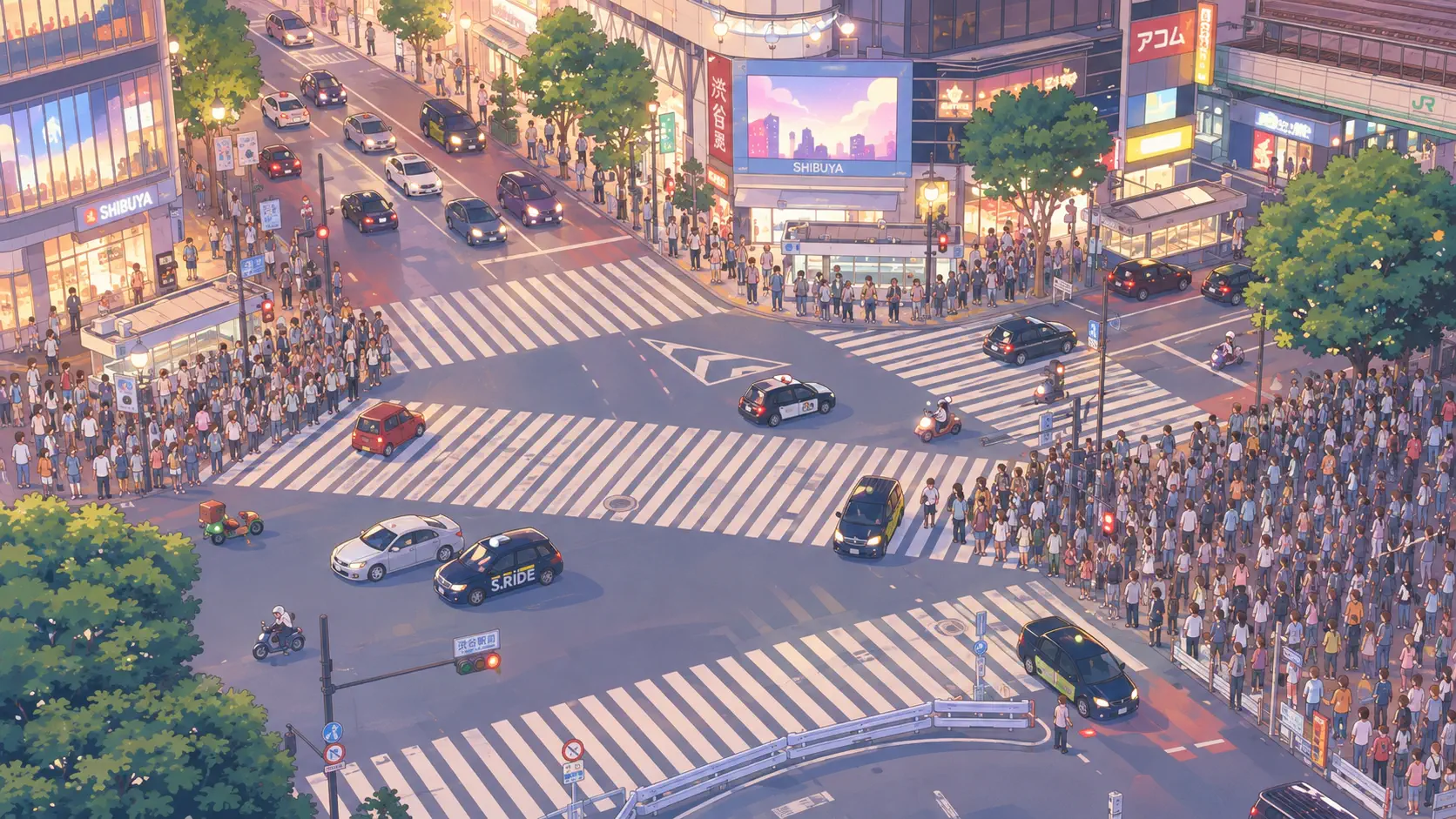
Shrine walks and scramble crowds share the same ward on different calendars. If you are watching movement on a Shibuya Crossing live view, this map is a reminder that many visitors eventually step off the live-camera frame into side streets where hatsumōde still looks like a local errand rather than a spectacle.
Hatsumōde weeks sit in cold-to-mild transition weather — pack with a Japan packing list for spring mindset.
Confirm current operation, event schedules, and access before visiting.