NEKO PUNCH arrived in Shibuya Channel’s Artist File series with a tagline that did half the work: London-born, dancing, near-future J-pop. By mid-2013 the trio — British-Japanese vocalist Leanne, producer-bassist MACC, and dancer Pinky — had just released their first maxi single Go Baby! on iTunes and were fielding questions about EMI auditions, odd stage layouts, and why their name sounded like a joke until it did not.
Who was in the room
Leanne — vocals, from the UK, also writes melodies, chords, tracks, and mixing on selected songs.
MACC — production and composition, positioned stage-left behind Leanne rather than beside her.
Pinky — self-described dancer, Fukushima-born acquaintance of Leanne’s, openly framed in the interview as an onee personality and the unit’s “night shift.”
The photo caption order ran Pinky – Leanne – MACC left to right. That staging was deliberate: MACC wanted empty space filled by movement, not extra guitars.
Formation: three meetings and a London album
MACC met Leanne in the UK, saw her briefly in Japan for about ten minutes, then reunited in London on a third visit — where they agreed to write together. That handshake became NEKO PUNCH, formally rolling in December 2012.
Leanne had struggled to find a compatible producer before MACC. Early sessions with his friends’ band yielded three songs she remembered as unexpectedly cool; afterward the pair kept producing as a duo.
By the time they spoke to Shibuya Channel, the group already held more than twenty finished tracks in the UK, even though live sets only exposed five or six. The stockpile was intentional — material aimed at Japan before Japan became home base.
Japan launch: EMI audition to Sendai arena
Activity in Japan began around January 2013. Their first live was an EMI audition — Revolution Rock Vol. 3 — where they beat roughly 4,000 entries and took grand prix despite famous producers watching from the room.
The second show escalated fast: EMI ROCKS SENDAI at Sendai Arena. Leanne called the pace a rollercoaster; MACC noted none of them had previously brushed against celebrity circles. Backstage was communal — Leanne remembered Kotaro Oshio (布袋) nearby, which froze Pinky.
Pinky admitted pre-show nerves; Leanne said the “NEKO PUNCH switch” flipped once on stage, making fear disappear. That split — rigid beforehand, transformed under lights — became a recurring theme.
Why Japan, and why a dancer
MACC had played Japan before (including FUJI ROCK) but never built a career there. In Europe he had worked with major names, yet hometown reactions stayed blank even when collaborators had Grammy credentials. He wanted a fully self-produced capstone project; NEKO PUNCH became the Japan-focused vehicle.
Leanne described their blend as complementary: MACC’s catchy, overseas-pop production against her slightly darker, more Japanese melodic tendencies.
Stage layout drove Pinky’s recruitment. MACC disliked standing shoulder-to-shoulder with Leanne and hated leaving the opposite side empty — but also rejected filling it with conventional rock instruments. A dancer solved the composition problem. Leanne supplied the introduction (“I know a weird but good person”), and a tentative “dance cover series” idea turned into a permanent third member.
After three people performed together, Leanne felt Pinky unlocked full-energy shows she could not reach alone. MACC observed audiences widening beyond genre lines — high-school girls with mothers, otaku, celebrities, and fans who came specifically to copy Pinky’s choreography. Crossing Japan’s rigid genre fences without forcing it mattered to him.
Name, branding, and “New Shibuya kei”
The name NEKO PUNCH came from banter: Leanne threw a playful punch, someone compared it to a cat swat, and they adopted the phrase on the spot. Early worries about sounding too otaku or idol-like led to a deliberate rebrand toward high-fashion neighborhoods — Daikanyama, Ginza — before media started calling them “New Shibuya kei” after TV appearances.
Leanne’s Japan story and language path
Leanne moved to Japan alone at eighteen, pulled by Japanese films — Memories of Matsuko and Shunji Iwai works with their beautiful, dead-end emotional worlds. She was questioning her UK studies and jumped.
Japanese improved through part-time jobs and conversation, not classrooms. She described growing up sheltered in the UK and “drinking bitter water” in Japan — meaning real-world education. MACC still teased her Japanese at the top of the interview; Pinky countered that she had improved plenty.
How the songs are built
On the Go Baby! maxi:
- “T-shirt” — Leanne
- “Go Baby!” — MACC
Leanne also handles atmosphere; MACC focuses on the hook-bearing core and heavy rhythm section — distorted bass, solid drums, catchy synths. He summarized the aesthetic as “not too rock, not too pop,” entertainment first, with cute vocals riding a gritty low end.
Lyrics are Leanne’s domain; MACC does not edit words. She aims for imagination-friendly, direct statements — communication she finds hard in speech. Pinky noted her blunt phrasing versus Japanese indirectness, plus a taste for cute lyrics that still punch.
Pinky’s choreography and MACC’s secret directing
Pinky never planned a professional dance career despite childhood idol imitation. The NEKO PUNCH offer felt like a spotlight fantasy coming true. MACC admitted whispering stage orders mid-show — “get off the stage, go into the crowd” — which explained why performances felt unruly in a good way.
Choreography starts from listening without lyrics, building skeleton movement, then refining once Leanne delivers text. “Oxygen,” their live opener, began dark but shifted toward showgirl / femme-fatale imagery once seductive lyrics arrived.
Influences and live philosophy
Leanne: 90s UK rock (Garbage, The Cardigans); Japanese acts including Ringo Sheena, Chara, JUDY AND MARY.
MACC: classical childhood (conductor father, no TV until teen years); MUSE live as the turning point after moving to the UK at eighteen — they even attended a MUSE show together in London. He contrasted MUSE’s rock show with the pop show he wanted to build.
Pinky: enka and kayō at home; idol-era Maki Goto peer energy; later Destiny’s Child / Beyoncé — including a concert so intense she hyperventilated on the train home and bought the full CD/DVD catalog.
Live goals converged on participation over observation. Pinky wanted theme-park energy; Leanne valued mixing cool, beauty, and slightly uncool humanity to close distance with the crowd. MACC kept repeating entertainment as the non-negotiable principle.
The koi ritual before showtime
Leanne and Pinky shared severe pre-show anxiety. Before their fourth live onward, they performed a absurd calming ritual: imagining themselves as slow, peaceful koi, chanting that they are peace and love. Hair and makeup staff mimed feeding them; MACC ignored the theater and set up gear. Leanne said it flipped her into “NEKO PUNCH’s Leanne” — the on-stage persona — reliably.
Release and career notes from the feature
- 1st maxi single: Go Baby! — released 28 June 2013 on iTunes; tracks “Go Baby!,” “Secret,” “T-shirt”
- Chart note in the original bio: reached No. 5 on iTunes Alternative
- Prior wins: EMI Revolution Rock Vol 3 grand prix; EMI ROCKS SENDAI appearance
- Live reference: Nihonbashi Aqua Artrium show praised during the interview
- Official links cited: nekopunch.me, Facebook, Twitter @leanne_NP
Shibuya questions closed the conversation. Leanne had lived in Shibuya early in Japan and still saw it as multinational and trend-generating. MACC emphasized youth density, color, and a near-future information overload — then invited Shibuya readers to discover NEKO PUNCH under the “New Shibuya kei” label they were already receiving.
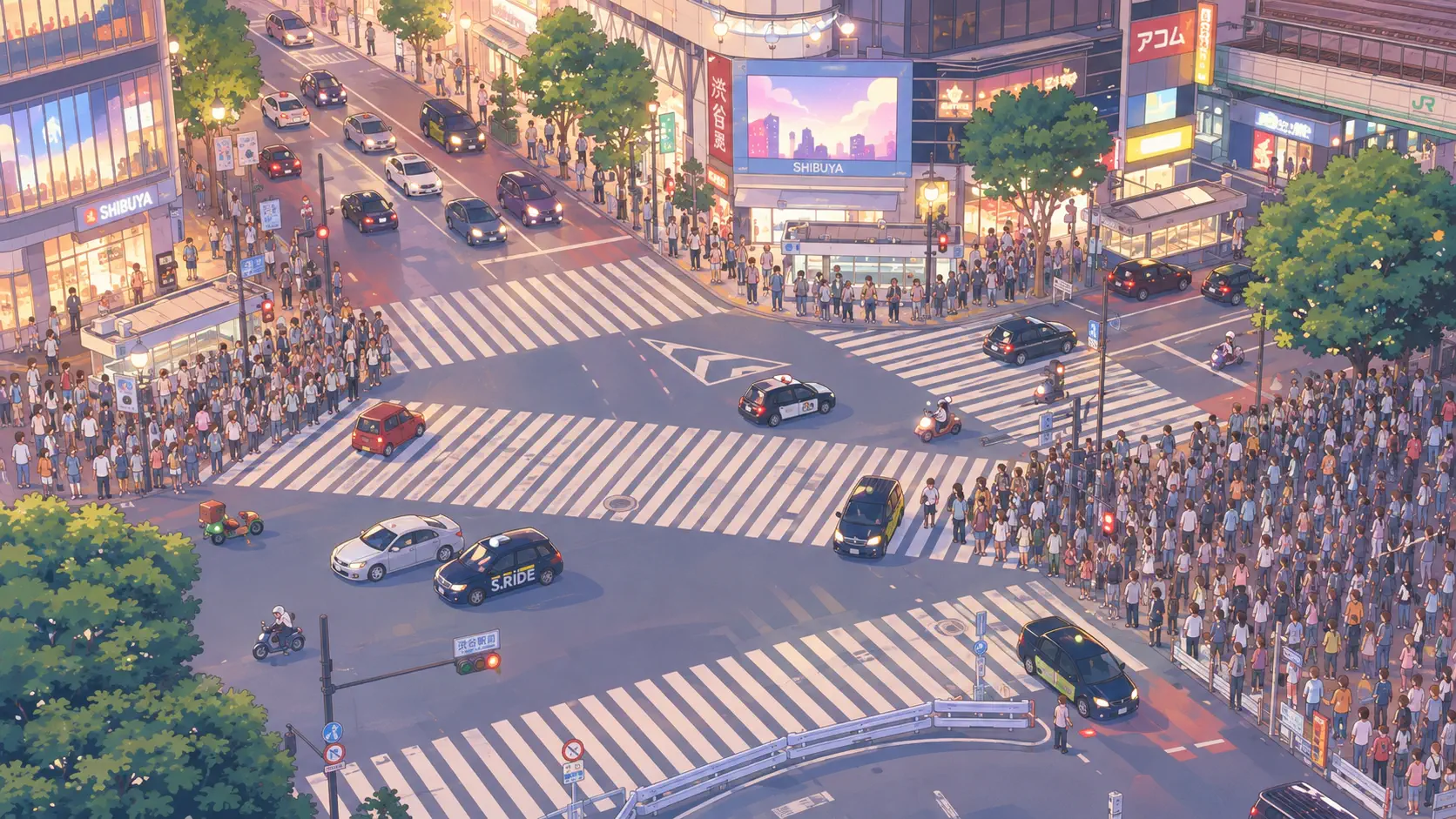
Watch the ward’s street layer on the Shibuya Crossing live camera, then return here for the live-house and pop-scene layer NEKO PUNCH tried to stitch together with dance. Readers connecting Artist File history to today’s street feeds can start with how to watch Japan live.